Tool · Colour
Skin tone and undertone finder
This skin tone finder reads the colour of your cheeks and forehead from one photo, in your browser. It names the depth band dermatology uses, says whether the colour leans warm, cool or neutral, and suggests colours and metals that tend to sit well. The photo never leaves your device, and daylight gives the truest reading.
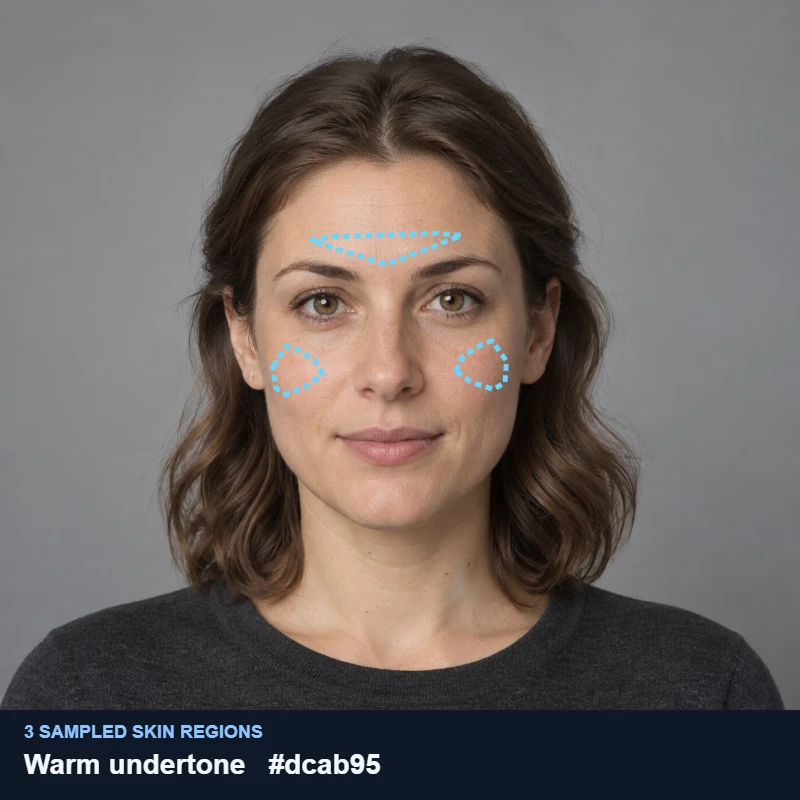
Example result
The three patches of skin the skin tone finder samples, on a demo portrait. Scan guides are enlarged here so you can see what the tool reads.
Read your skin tone and undertone
- Even light
- Neutral expression
- Phone at eye level
- Clean background
- Even lightFace a window. No harsh shadows from above.
- Neutral expressionNo smile, no makeup. Hair off your forehead.
- Phone at eye levelShoulders to top of head. Chin neither up nor down — angle can fake a sharper jaw.
- Clean backgroundPlain wall or neutral space.
What does the skin tone finder read?
Two things, from the same patches of skin. The tool places a face mesh on your photo, outlines three areas of bare skin, the cheek under each eye and the lower forehead, and converts every pixel in them to CIELAB, the colour space built to match how people see differences in colour. It throws out what is not skin (a stray hair, a freckle cluster, a shiny spot) and takes the middle value of what is left, so one odd pixel cannot move the answer. From that one colour it reads depth and leaning.
Depth is the Individual Typology Angle, a single number computed from how light the skin is and how yellow it is. Dermatology has used it since a 1991 paper in the International Journal of Cosmetic Science to describe skin colour without the vague words people usually reach for, and a 2006 study in Pigment Cell Research grouped it into the six bands below, each tied to how skin of that colour responds to sun. The bands are descriptions. None is a grade, and the tool never passes the result anywhere.
| Band | What it describes |
|---|---|
| Very light | The palest group; lightness high, little yellow |
| Light | Light skin with more colour than the palest group |
| Intermediate | The middle of the range |
| Tan | Mid-depth skin with clear warmth |
| Brown | Deeper skin, lightness below the middle |
| Dark | The deepest group |
Leaning is the hue angle of the same colour: whether it sits closer to yellow or closer to red. Stylists call that undertone. There is no colorimetric standard for undertone, so the tool does not pretend to measure a type; it reports which way the colour leans and how clean the photo was.
How to take the photo for a skin tone reading
For geometry tools the lens position matters most. For colour, the light does. The camera records the skin as lit, so a yellow bulb makes every face read warmer and shade makes it read cooler. These rules keep the light out of the answer.
- Daylight, facing a window. Indirect daylight is the most neutral light most people have. Stand so it falls evenly on both cheeks.
- No flash, no filter, no beauty mode. Flash blows out the cheeks; filters and beauty modes shift colour on purpose.
- Bare cheeks if you can. Foundation, bronzer and tinted sunscreen are read as skin. The tool reads the surface it sees.
- Hair off the forehead. A fringe shrinks the forehead patch to nothing and the reading rests on the cheeks alone.
- A plain mid-tone or pale background. The camera exposes for the whole frame: a black backdrop makes it brighten everything, skin included, and a white one makes it darken everything, which moves the depth by a band. A strongly coloured wall bounces its colour onto the face.
The card tells you when a photo breaks one of these: one cheek much darker than the other means side light, clipped white pixels mean too much light, a very dark or very bright backdrop means the depth has been pushed, and a yellowish or bluish cast in the whites of the eyes or the brightest parts of the frame means the light itself is coloured. The same setup helps a full rating, as how to take a photo for a face rating explains.
Warm, cool or neutral: what the leaning means
A warm leaning means the skin's colour sits toward yellow and gold; a cool one, toward pink and red; neutral sits between. It is independent of depth: very light skin can lean warm, dark skin can lean cool. Olive skin, with its greenish cast, usually reads neutral to warm here, because the tool looks at the yellow-red axis only. The folk tests, the colour of your wrist veins or whether gold or silver jewellery looks better, are trying to see the same leaning, and they fail for the same reason a photo can: light changes what you see. The advantage of the tool is not precision, it is that it states its conditions. Take two photos in different daylight and compare; if both lean the same way, the leaning is yours.
Colours and metals that tend to suit each leaning
The palettes below are styling rules of thumb, not findings: they come from how colourists and stylists pair clothing and hair with skin, and the tool shows the one that matches your leaning. Depth changes how much contrast looks deliberate, so the card adds a note for your band.
| Leaning | Colours | Metals | Hair colours to try |
|---|---|---|---|
| Warm | Camel, olive, rust, terracotta, mustard, warm ivory, tomato red, teal | Gold, brass, bronze | Honey blonde, caramel, copper, auburn, chestnut |
| Neutral | Dusty rose, jade, soft white, taupe, denim blue, plum, mauve, warm grey | Either; rose gold is the easy middle | Chestnut, dark brown, honey blonde, ash brown, auburn |
| Cool | Navy, emerald, sapphire, berry, burgundy, pure white, charcoal, icy pink | Silver, white gold, platinum | Ash brown, ash blonde, platinum, soft black, burgundy |
The hair colours in the last column are starting points (on deeper skin the lightest blondes are swapped for a deeper shade of the same leaning); test a strand before anyone mixes a dye.
What the skin tone finder cannot tell you
It is not a colorimeter. A dermatologist's instrument touches the skin and brings its own light; a phone photo depends on the light in the room, the camera's white balance and the compression of the file, and each of those moves the numbers. Treat the band as a description that can be one step off, and the leaning as reliable only when repeat photos agree. It is not a medical tool either. It does not assess moles, pigment disorders or sun damage, and it is not the Fitzpatrick phototype, which is about how skin burns and tans and is asked in a consultation, not read from a picture. What it will never do is rank skin. The perception research the rating rests on is about evenness, not depth: studies in 2006 and 2007 changed only how evenly colour was spread across the same face and found evenness moved how young and healthy it looked. That is why the rating reads evenness and texture and ignores depth completely.
Questions
Why does my skin tone result change between photos?
Because the light changes, not your skin. A warm bulb, a shaded balcony and a phone's automatic white balance each shift the colour the camera records, and the depth band or the leaning can move by a step. Take the photo facing a window in daylight, twice, and trust the answer the two photos agree on.
Is the undertone result the same as a colour season analysis?
It is one input to one. Seasonal analysis combines skin leaning with depth and with the contrast between skin, hair and eyes, and a consultant drapes fabric under controlled light. This tool reads the skin part from a photo and suggests a palette from the leaning alone, which is a quick first answer rather than a full seasonal typing.
Does the skin tone finder work on darker skin?
Yes. The depth bands cover the whole range, and the photo checks look for clipped and crushed pixels rather than for dark skin, so deep skin is never flagged as a bad photo for being deep. Two things matter more for deeper skin: light from the front, because side and overhead light lose colour detail first, and the backdrop, because a black one makes the camera brighten the photo and the depth read lighter. The card warns about both.
Is my skin tone used in the BecomeTen rating?
No. The rating does not read skin depth or leaning at all and has no separate scale by skin colour. It reads evenness, texture, blemishes and under-eye condition, the things a routine can change. This tool's result stays on your device and is not sent to the rating or anywhere else.
Can makeup or a tan change the skin tone reading?
Yes, both. The tool reads the surface it sees, so foundation, bronzer or tinted sunscreen are measured as if they were skin, and a summer tan genuinely deepens the band for a few months. For a baseline, photograph bare skin outside the tanning season; for choosing colours to wear right now, photograph yourself as you are.
Sources
- 1.Skin colour typology and suntanning pathways — International Journal of Cosmetic Science (1991)(Opens in a new window)
- 2.Relationship between skin response to ultraviolet exposure and skin color type — Pigment Cell Research (2006)(Opens in a new window)
- 3.Visible skin color distribution plays a role in the perception of age, attractiveness, and health in female faces — Evolution and Human Behavior (2006)(Opens in a new window)
- 4.Color homogeneity and visual perception of age, health, and attractiveness of female facial skin — Journal of the American Academy of Dermatology (2007)(Opens in a new window)