Tool · Harmony
Face shape detector
This face shape detector finds your face shape from one photo, in your browser. It places landmarks on the face, compares forehead, cheekbone, jaw and chin widths with face length, and names the closest common shape: oval, round, square, oblong, heart or diamond. The photo never leaves your device, and the result is an estimate, not a measurement.
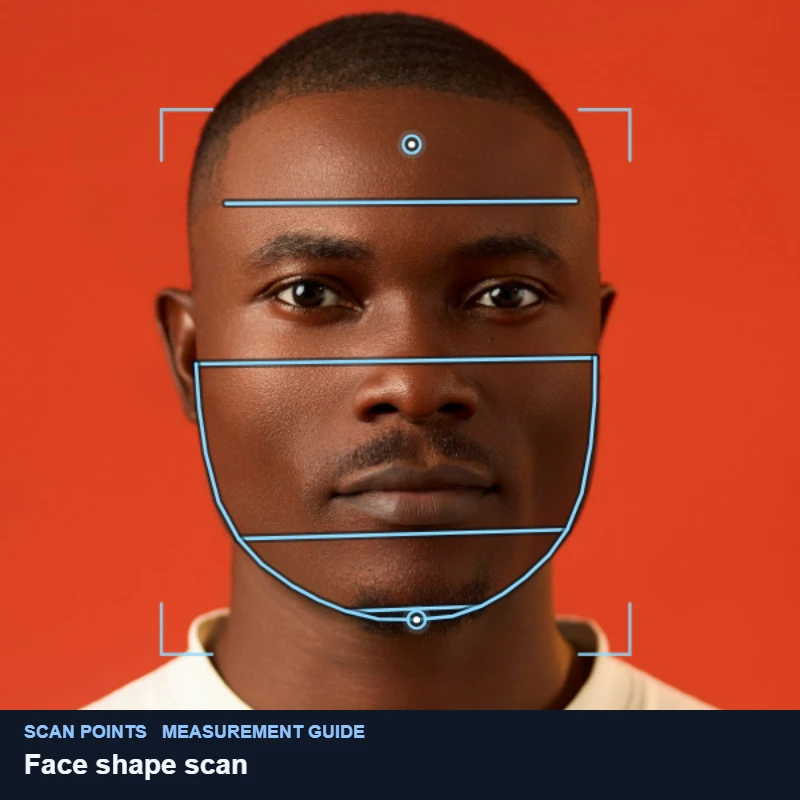
Example result
The forehead, cheekbone, jaw and chin widths the detector compares, on a demo portrait. Scan guides are enlarged here so you can see what the tool reads.
Face shape detector
- Even light
- Neutral expression
- Phone at eye level
- Clean background
- Even lightFace a window. No harsh shadows from above.
- Neutral expressionNo smile, no makeup. Hair off your forehead.
- Phone at eye levelShoulders to top of head. Chin neither up nor down — angle can fake a sharper jaw.
- Clean backgroundPlain wall or neutral space.
Embed this test on your siteFree, no sign-up
Paste this where you want the face shape detector to appear: a blog post, a forum signature page, a barber's or clinic's site. It runs in your visitor's browser and never uploads their photo, so there is nothing to add to your privacy policy for it.
What does the face shape detector compare?
Face shape is a description of proportion, not a single feature. The tool runs a face mesh on the photo in your browser, finds the outline of the face and reads its width at four heights: across the forehead, across the cheekbones, across the jaw at its corners, below the ears, and across the chin. It reads the length of the face from the top of the forehead to the bottom of the chin. Then it compares those widths with each other and with the length, and names the shape whose ratios sit closest to yours. No pixel of the photo is sent to a server; the classification happens on your device and disappears when you close the tab.
| Shape | What the ratios look like |
|---|---|
| Oval | Face clearly longer than wide; cheekbones the widest point; jaw a little narrower than cheekbones, chin gently rounded |
| Round | Length and width close to each other; cheekbones widest; jaw soft and about as wide as the forehead |
| Square | Length and width close; forehead, cheekbones and jaw all similar in width; jaw angle reads flat and wide |
| Oblong | Face much longer than wide; forehead, cheekbones and jaw similar in width; the long version of square |
| Heart | Forehead wider than jaw; cheekbones wide; chin narrow and pointed |
| Diamond | Cheekbones clearly the widest point; forehead and jaw both narrower; chin narrow |
Most faces sit between two of these. That is not a failure of the tool; the names are bins drawn over a continuous range. The result names the nearest bin and shows the ratios behind it, so you can see whether you are deep inside one shape or on the border between two. The bone that sets these widths is covered under zygomatic bones and mandible.
How to take the photo for a face shape reading
The classifier compares widths at different heights, so anything that changes one width and not another changes the shape it picks. The rules below remove the usual distortions.
- Camera at eye level, face square to the lens. A camera held above the eyes shrinks the jaw and turns a square face into a heart; a camera below the eyes does the reverse.
- Arm's length or further. A close phone lens enlarges whatever is nearest, usually the nose and forehead, and narrows the outer face. Prop the phone and use the timer if that helps.
- Hair fully off the forehead and away from the sides. A fringe or hair over the temples can pull the forehead points of the mesh inward and fake a narrow forehead, so hair off the forehead gives a cleaner width.
- Even light from the front. Side light shadows one jaw edge and makes the face read narrower on that side.
- Neutral expression, mouth closed. A smile widens the lower face and lifts the cheeks; a clenched jaw squares it.
The same setup is what a full rating needs. The longer version, with the reasons, is in how to take a photo for a face rating.
How to read your face shape result
The result shows the named shape and the ratios that led to it: how much longer than wide the face is, how the forehead compares with the jaw, and how the jaw compares with the cheekbones. Read the ratios first and the name second. A face that is only slightly longer than wide, with a jaw almost as wide as the cheekbones, is near the border of round and square, and the name can flip between two photos taken minutes apart. When two shapes are close, both apply for practical purposes, and the guides on this site say what to do with either. The most useful thing to do with the shape is decide framing. Hairstyle by face shape and glasses by face shape both start from the shape and work outward, and both are about composition, which is workable, rather than about bone, which is not.
What the detector cannot tell you
It cannot measure your face. A photograph is a flat projection of a three-dimensional head, and the widths it reads depend on where the lens was and which way the head was pointing. A slight turn makes one cheek larger than the other; a tucked chin shortens the lower face. The tool reports an estimate from one image, and two honest photos can land in neighbouring shapes. If the result surprises you, take a second photo with the rules above before you believe either. It also cannot tell you whether your shape is good. No face shape is rated higher than another in the perception research. The evolutionary reviews of facial attractiveness from 2006 and 2011 support averageness, symmetry, skin condition and sex-typical features; none of them names oval, or any other shape, as a target. A shape is a description you can dress for, not a score.
Is face shape structural or workable?
The widths the tool reads sit on bone: the forehead on the frontal bone, the cheekbones on the zygomatic arches, the jaw on the mandible. Bone width does not change with exercise, chewing, tongue posture or massage, and BecomeTen does not recommend surgery to change it. In that sense face shape is structural, and nothing on this site promises to turn one shape into another. What is workable is the layer over the bone and the frame around it. Cheek and jaw fat add width at the lower face, so a round reading can move toward oval as body fat drops, and back again if it rises. Hair adds or removes width at the forehead and temples. A beard adds width and length at the chin. None of that moves the skeleton, but the shape the camera sees is the shape other people see, and that one is partly yours to compose.
What to do with the result
Questions
Is one face shape more attractive than another?
Not in the research. The reviews of facial attractiveness from 2006 and 2011 find support for averageness, symmetry, skin quality and sex-typical features, and none of them ranks shapes. An oval face is often called ideal in styling articles because it is easy to frame, which is a statement about haircuts, not about beauty.
Why does the face shape detector disagree with what a stylist told me?
Both are estimating, from different inputs. A stylist looks at your head in three dimensions, with hair, and usually rounds toward the shape that suits the cut they have in mind. The tool reads widths off one flat photo with strict rules. When the two disagree, your face is almost certainly between the two named shapes, and either answer is usable.
Does hair on my forehead change the detected face shape?
Yes, more than any other single thing. A fringe or hair over the temples can pull the forehead points of the mesh inward, so the forehead reads narrow and pushes the result toward heart or diamond. Pull the hair fully back, or clip it, before the photo, and take the result with the hair down as a reading of your hairstyle rather than your face.
Can weight loss change the face shape the tool reports?
It can move a borderline result, because fat at the cheeks and along the jaw adds width the bone does not have. A face reading round at a higher body fat often reads oval or square when leaner, and the underlying bone has not moved at all. A face already lean stays in the same shape whatever the diet.
Does a beard confuse the face shape detector?
It can. The mesh finds the jaw and chin from skin and shadow edges, and a full beard hides both, so the chin width and face length get read from the beard's outline instead. A short, tidy beard barely matters. For a reading of the face itself, photograph clean-shaven or as trimmed as you are willing to go.