Tool · Harmony
Visual weight test: high or low?
This visual weight test reads the two things the TikTok theory describes, from one photo, in your browser: how large your eyes, lips and nose are for your face, and how strongly your brows, eyes and lips contrast with your skin. It names high, medium or low visual weight and shows both parts, so you can see which one drives the result.
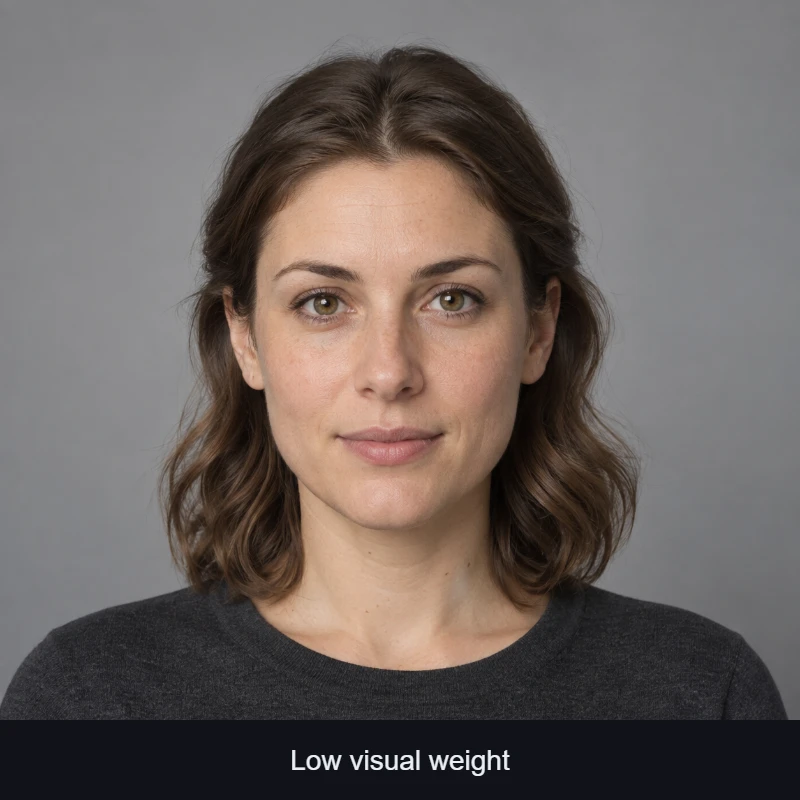
Example result
A visual weight reading from feature size and contrast on a demo portrait.
Find your visual weight
- Even light
- Neutral expression
- Phone at eye level
- Clean background
- Even lightFace a window. No harsh shadows from above.
- Neutral expressionNo smile, no makeup. Hair off your forehead.
- Phone at eye levelShoulders to top of head. Chin neither up nor down — angle can fake a sharper jaw.
- Clean backgroundPlain wall or neutral space.
What is visual weight?
Visual weight is a makeup theory that spread on TikTok. It says some faces draw the eye to individual features, because the features are large or dark against the skin, and others read as a soft whole. High visual weight faces are said to carry bold makeup, strong brows and dark lips; low visual weight faces are said to look best in softer, sheerer looks that do not sit on top of the face. It is a styling idea borrowed from design, where visual weight means how much an element pulls the eye.
The popular test is to push a photo's contrast up and down and see at which end the features look better. That mostly tests the filter. This tool measures the two ingredients directly instead: feature size, from the face mesh, and feature contrast, from the colours in the photo.
How the visual weight test works
| Part | What is measured | Bands |
|---|---|---|
| Feature size | Eye area, lip area and nose width, each against the width of the face | Larger, typical, smaller |
| Contrast | How far the brows, eyes and lips differ in lightness from the cheeks, relative to the skin's own lightness | High, medium, low |
| Visual weight | Half size, half contrast | High, medium, low |
Each reading is compared with real frontal photos run through the same measurement, so high means higher than typical, not a fixed number. Contrast is measured relative to your skin, not on an absolute scale, so a face of any skin depth can be high or low contrast: dark brows and eyes on light skin and very dark features on medium skin can both read high. The photo is read on your device and never uploaded.
How to take the photo
- Daylight from a window, no flash. Contrast is read from the pixels, and overhead or coloured light changes it.
- Bare face or light makeup. Mascara, brow pencil and lipstick raise contrast; that is what makeup is for, but it is not your baseline.
- No filter or beauty mode. Smoothing filters lower contrast and enlarge the eyes.
- Straight on, relaxed face, hair off the brows. A smile changes the lip area and squints the eyes.
What to do with your result
Treat the result as a starting point for makeup, not as a verdict on your face. No band is better than another, and the research on attractiveness does not measure visual weight at all; what it does find is that contrast around the eyes and lips reads as youthful and feminine in many faces, which is the grain of truth under the theory. High visual weight faces can wear high-contrast looks without being overwhelmed. Low visual weight faces often look best when makeup follows their own contrast: tinted rather than drawn brows, sheer lips, soft liner. Medium, the most common result, has the most room either way.
Contrast is also partly workable. Tinting brows and lashes raises it; very light brows or a heavy foundation lowers it. The skin tone finder reads the depth and undertone of the skin the contrast is measured against, and the lip shape test and eye type test describe the features themselves.
Questions
Is high visual weight more attractive than low?
No. Visual weight is a makeup theory about which looks suit a face, not a rating. Faces at both ends are rated highly all the time. The theory's only claim is that makeup looks best when it matches the face's own size and contrast, and the tool reports your band so you can test that for yourself.
Does skin colour decide visual weight?
Not in this test. Contrast is measured as how much the brows, eyes and lips stand out from your skin relative to the skin's own lightness, so light, medium and deep skin can each read high or low. What matters is the difference between the features and the skin, not the skin itself.
Can makeup change my visual weight?
It changes the contrast half, which is why the test works best on a bare face. Tinted brows, mascara and a darker lip raise contrast; very light brows and full-coverage foundation lower it. Feature size is set by bone and tissue and does not change with makeup, though liner and lip liner can shift how large features read.
Sources
- 1.Facial attractiveness: evolutionary based research — Philosophical Transactions of the Royal Society B (2011)(Opens in a new window)
- 2.Color homogeneity and visual perception of age, health, and attractiveness of female facial skin — Journal of the American Academy of Dermatology (2007)(Opens in a new window)