Journal · Hair · evidence
Minoxidil vs finasteride: what the trials show for hairline and density
Both have randomized-trial evidence in men with pattern hair loss. Topical minoxidil increased hair counts against placebo, with the stronger solution outperforming the weaker one. Oral finasteride increased hair counts and slowed loss against placebo, and is prescription-only. Both take months, both were mainly measured at the crown, and the hairline responds less predictably.
A claim should come with its context.
Evidence levels describe support for a claim, not a guaranteed result.
Read the methodologyInside this article
Find the part you need.What do the trials show for minoxidil?
Minoxidil is the over-the-counter option and the one with the least friction to start. It is applied to the scalp, and the mechanism is still not fully understood, which is unusual for something with this much trial data behind it.
That is the whole honest headline. More hair than placebo, measured by counting hairs in a fixed area of the crown, over a timescale of a year. Not a full head of hair, not a restored hairline, and not a two-month change.
What does the finasteride trial show, and why is it prescription-only?
Finasteride works on the hormone pathway that drives pattern loss in men, which is why it slows the loss rather than only stimulating regrowth. The 1998 trial is the reference result: men on finasteride kept more hair and grew more than men on placebo, and the gap widened over the second year.
It is a prescription medicine for a reason. It acts systemically, it has a known side-effect profile that includes sexual side effects in a minority of users, and whether it is appropriate for you depends on your age, your health and your tolerance for those risks. That discussion belongs with a doctor, and BecomeTen will never tell you a dose, a schedule or that you should start it. What we will tell you is that the evidence is real and strong, which is more than most hair advice can say.
The same applies to dutasteride, which sits in the same class; there is no entry for it in our library, so any plan step mentioning it is labelled as having no studies in our pool, regardless of what exists elsewhere.
Why does hair regrowth take months?
Because of how follicles work, not because the products are slow. A 1999 review of hair-follicle biology in the New England Journal of Medicine lays out the cycle every follicle runs through: a long growth phase, a short regression phase and a resting phase, after which the old hair is shed and a new one starts. Pattern loss shortens the growth phase and shrinks the follicle, so each cycle produces a finer, shorter hair.
A treatment that pushes follicles back toward growth cannot show anything until resting follicles have shed and the new hairs have grown long enough to see. That is months. It is also why the first weeks on minoxidil can bring more shedding, not less: follicles are being pushed out of rest early. The trials measured at a year for the same reason, and a plan that promises visible density in a month is not describing hair biology.
One photo. Then stop guessing.
Check whether density or hairline is the trait costing you points before you commit to a year of anything.
Does either one work on the hairline specifically?
This is the question most people actually have, and the honest answer is that the cited trials were mainly measured at the vertex, the crown, because that is where hair counts can be taken reproducibly. The frontal hairline and temples are widely regarded as the harder region, and the evidence there is thinner than at the crown. We will not tell you a recession will reverse.
What we can say is that slowing loss applies everywhere the follicles are still alive, and that density behind the hairline responds in the trial data. A follicle that has been gone for years has nothing left to stimulate, which is the other reason timing matters: the earlier loss is addressed, the more there is to keep.
What about ketoconazole, laser and microneedling?
Three adjuncts come up constantly. Each has something in our library, and each sits at a lower evidence level than the two main options.
| Adjunct | What the study is | Evidence level |
|---|---|---|
| Ketoconazole shampoo | A 1998 study of long-term use in androgenic alopecia reported improved hair density; small and not placebo-controlled in the standard sense | Weak |
| Low-level laser (light) therapy | A 2014 review of the trial literature reports a positive signal, with variable device quality and study design | Weak to moderate |
| Scalp microneedling | A 2013 randomized, evaluator-blinded pilot found microneedling added to minoxidil outperformed minoxidil alone; small and single-centre | Weak |
None of these replaces the two main options, and none has a randomized trial of the size behind minoxidil or finasteride. They are plausible additions, labelled as such. Microneedling in particular breaks the skin and belongs with someone trained, not with a roller bought online.
What hair does to how the face reads
Hair is only a small share of the overall score, but it frames every other area. The face is read in thirds, and the upper third runs from the hairline to the brows. A receding hairline lengthens that third in a photo, which shifts how the whole face reads without any change to the face itself. A fuller hairline, or a cut that lowers the visual start of the hair, does the reverse.
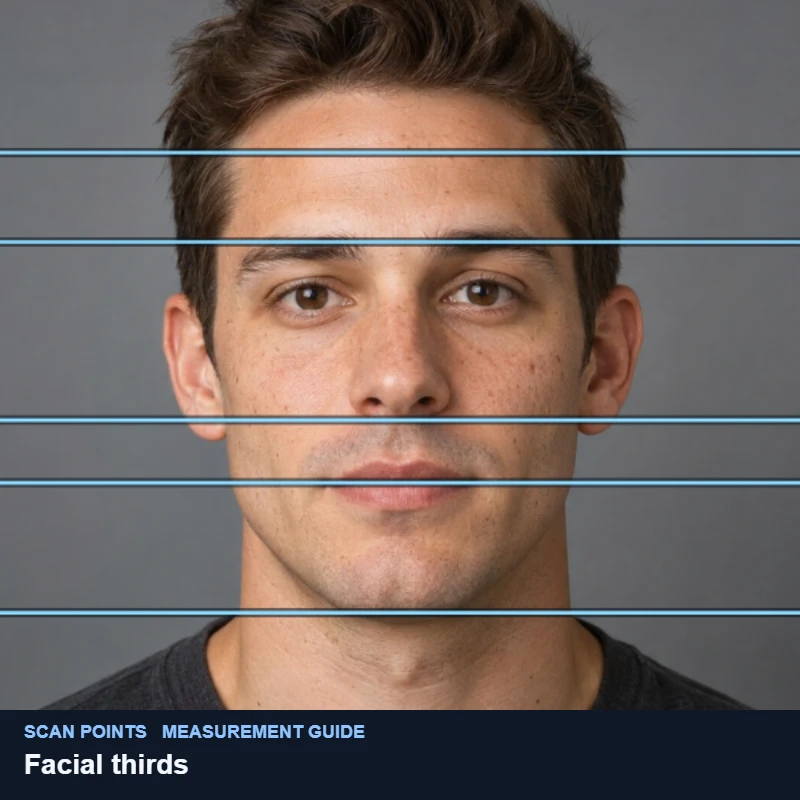
This is where the fast wins live. Regrowth takes a year; a cut that suits your recession pattern, a hairline shaped rather than exposed, and hair kept in good condition change how the thirds read in an afternoon. The rating's hair traits are density, hairline, condition, style fit and facial hair, and every one of them is tagged workable.
Why is the hair cap +20?
Hair gets the second-largest non-surgical ceiling in BecomeTen, +20 on the hair dimension, after skin. The reasoning is simple: every hair trait moves. Style and condition move in weeks, density and hairline move over a year with medicines that have randomized-trial evidence, and facial hair is entirely yours to decide. The ceiling is high because the evidence is strong and the traits are soft, not because we are being generous.
That makes hair a core piece of softmaxxing and one of the few areas where the looksmaxxing conversation and the medical literature actually agree. The gap is in the framing: the forums talk in miracles and the trials talk in hair counts at a year. We use the trials.
Questions
Do I have to keep using minoxidil forever?
The trials measured hair while the product was in use, and the follicle biology says a follicle that is no longer being stimulated returns to its previous cycle. The standard understanding is that regrowth is lost within months of stopping. Treat both minoxidil and finasteride as maintenance decisions, made with a doctor for the prescription one, rather than a course you complete.
Is the shedding in the first weeks normal?
It is expected. Minoxidil pushes resting follicles into a new growth phase, and the old hair in each of those follicles is shed to make room. It looks alarming and usually settles within a couple of months as the new hairs come through. If shedding is heavy, patchy or continues well beyond that, it is a reason to see a doctor, not to change how you use it on your own.
Can I use minoxidil and finasteride together?
They act on different mechanisms, one stimulating growth and one reducing the hormonal driver of loss, and they are commonly used together. Whether that is appropriate for you is exactly the kind of question the prescribing doctor answers. We describe the evidence for each; combining medicines is a clinical decision, not a rating-app recommendation.
Does this apply to women's hair loss?
The trials cited on this page enrolled men with male pattern loss. Female pattern hair loss has its own literature, including a Cochrane review of the interventions, and its own set of options and contraindications, and finasteride in particular has specific restrictions for women of childbearing age. That is a dermatologist conversation from the start, and nothing on this page should be read as applying to it.
Sources
- 1.Interventions for female pattern hair loss — Cochrane Database of Systematic Reviews (2016)(Opens in a new window)
- 2.A randomized clinical trial of 5% topical minoxidil versus 2% topical minoxidil and placebo in the treatment of androgenetic alopecia in men — Journal of the American Academy of Dermatology (2002)(Opens in a new window)
- 3.Finasteride in the treatment of men with androgenetic alopecia — Journal of the American Academy of Dermatology (1998)(Opens in a new window)
- 4.The biology of hair follicles — New England Journal of Medicine (1999)(Opens in a new window)
- 5.Ketoconazole shampoo: effect of long-term use in androgenic alopecia — Dermatology (1998)(Opens in a new window)
- 6.Low-level laser (light) therapy (LLLT) for treatment of hair loss — Lasers in Surgery and Medicine (2014)(Opens in a new window)
- 7.A randomized evaluator blinded study of effect of microneedling in androgenetic alopecia: a pilot study — International Journal of Trichology (2013)(Opens in a new window)