Journal · Measurement · progress
Scan the change, judge the trend at 6–8 weeks
Track facial progress by photographing under the same conditions every time — window light, phone at eye level, same distance, neutral face — and judging the trend at 6–8 week checkpoints rather than scan to scan. Changes within two points are noise. Angle is the variable that lies most, so hold it constant.

Inside this article
Find the part you need.Log often, judge at checkpoints
Scan when you have a change worth comparing, such as a haircut. Use 6–8 weeks as a review checkpoint, not a deadline for results. Keep the photo setup consistent and compare several scans; a single number cannot show whether a routine is working.
Angle lies the most
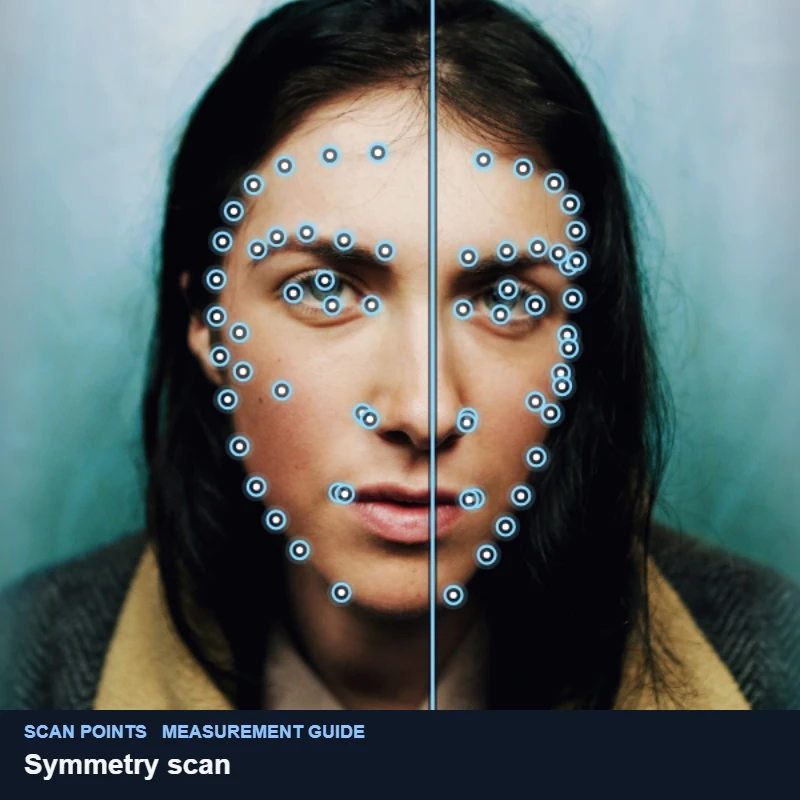
A tilted-down chin makes the jaw and chin read smaller and softer and shifts the entire lower-third score. A tilted-up chin does the reverse: the jaw underside shows and the jaw reads heavier. Stand by the same window, hold the phone at eye level and keep a neutral expression. During a re-scan, BecomeTen shows your original photo as a faint alignment layer on the camera screen so you can line up the same framing. The full list of what moves which area is in photo quality: light, angle and lens.
The repeatable setup
The goal is not a flattering photo. It is a photo you can take again in two months and get the same result if nothing has changed. Everything below is about removing variables, and once it is set up it takes less than a minute.
- Face a window in daylight, not direct sun. Even, front-on light shows skin and shape without carving shadows. Turn off overhead lights.
- Phone at eye level, held or propped so the lens is level with your eyes, not above or below. A tripod or a shelf beats an outstretched arm.
- One step further back than feels natural, then use the rear camera or the standard zoom. A phone close to the face enlarges the nose and shrinks the jaw.
- Neutral expression, mouth closed, teeth not clenched. A smile lifts the cheeks and narrows the eyes; a clench widens the jaw.
- Hair off the face the same way each time, no hat, no glasses. Same time of day if you can.
- Note the spot. Same window, same distance, same phone. The scan compares photos, not memories.
Score and tier free once a day, no sign-up. The first one is your baseline.
How BecomeTen grades a capture and when it withholds a comparison
Every photo is graded before it is scored, on three things: lighting (good, uneven or poor), angle (frontal, slightly off or off) and sharpness (good, soft or blurry). A photo can fail any one of them and still be rated — the score stands — but it is flagged as lower quality so you know that tracking from it will be less precise.
On a re-scan the rule is stricter. The change from your baseline is shown only when both photos pass the capture grade. If either one does not, the comparison is withheld and the report says why: a subtraction between a good photo and a bad one is not a change, it is noise dressed up as a number. The model also sees both photos side by side and may only report differences it can see; the prompt forbids inventing progress, so unchanged and regressed are ordinary outcomes.
Why is ±2 points noise?
Two photos of the same face on the same day, taken a metre apart or ten minutes apart, will not score identically. The rater is an estimate from a single two-dimensional image, and small differences in light, angle and focus move the estimate a little. BecomeTen counts any change within two points as measurement noise and shows it neutrally rather than as progress or regression.
This is the same logic any measurement uses. A bathroom scale that reads 80.2 then 80.4 is not telling you that you gained weight. A score of 57 that becomes 58 is not telling you the retinoid worked. It might have; the number cannot say yet. Three or four points, held across two checkpoints on comparable photos, is a different matter.
| Change | Photos comparable? | Read it as |
|---|---|---|
| Within ±2 | Yes | Noise. Wait for the next checkpoint. |
| Any size | No | Withheld. Retake under the setup above. |
| 3 or more, one scan | Yes | A candidate signal. Confirm at the next checkpoint. |
| 3 or more, two checkpoints | Yes | A trend. The change is probably real. |
Water, sleep and the day-to-day face
Faces change day to day for reasons that have nothing to do with a routine. Sodium, alcohol and a poor night's sleep all show in the morning as fullness, puffiness under the eyes and a duller tone; a long walk and a normal night undo them. None of this is progress or regression, and all of it moves an individual scan.
The practical rule: scan on an ordinary morning, not after a late night, a flight or a heavy meal. If the only photo you have was taken on a bad day, treat that scan as a data point, not a checkpoint.
What a real trend looks like
A useful trend is repeated and area-specific; it need not improve at every checkpoint. Skin tone and clarity move first, usually from about three months into a routine with evidence behind it. Submental and jawline definition move with body composition over two to four months. Hair density, if it moves at all, takes three to six months and often dips before it climbs. Harmony barely moves, because bone does not.
Look for a repeated change in the same area across comparable photos. If every area jumps together, check the lighting and camera setup first. The headline averages all five areas, so a change in one area can be less obvious there.
What PRO progress tracking does
A single full report is a one-time purchase, and a re-scan against it can be bought one at a time. BecomeTen PRO, at €9.99 a month or €59.99 a year, includes 20 scans per rolling 30 days (at most three a day), a potential photo with every scan, and progress tracking. Progress tracking means: your scans plotted over time per area, each re-scan compared with your baseline under the capture-grade rule above, the weak points that resolved and the ones that appeared, and your real baseline and current photos shown side by side, separate from any AI simulation.
It also refuses two things. It will not compare two photos that appear to be two different people, because PRO and progress tracking are for one person. And it will not report a change in bone geometry between scans, because there is none to report. The tier ladder is fixed, so a tier change is a genuine movement on the scale, not a shift relative to other users.
Questions
Should I scan every day?
No. Daily scans add noise, not information — light, sleep and water move the estimate more than a day of any routine does. Scan when something has actually changed, and treat the 6–8 week checkpoint as the point where you judge. PRO's allowance of 20 scans per 30 days is sized for checkpoints, not daily use.
Can I compare a scan taken with a different phone?
You can, but read it cautiously. Different lenses and processing change sharpness, colour and the apparent width of the face. The capture grade catches gross differences, and a lower-confidence note is shown when the two photos differ in lighting or angle. For a clean trend, keep the same phone for the whole series.
What if my score goes down at a checkpoint?
Check the photo conditions and which area moved. A drop larger than two points is worth checking, but one scan does not prove a real change. Confirm it with another comparable photo before changing your routine.
Do I need PRO to track progress at all?
No. Any re-scan against a full report shows the change from baseline. PRO makes it practical: 20 scans per rolling 30 days rather than paying per re-scan, the curve over time, resolved and new weak points, and the side-by-side of your real photos. If you plan to scan at more than a couple of checkpoints, it is the cheaper route.