Journal · Hair · evidence
What does your Norwood stage do to your face score?
The Norwood scale is a seven-stage description of male pattern hair loss, from no recession to a horseshoe of remaining hair. A frontal photo shows the hairline and the density in front but not the crown, so BecomeTen scores hairline and density as approximate bands, and never assigns a Norwood number.
A claim should come with its context.
Evidence levels describe support for a claim, not a guaranteed result.
Read the methodologyInside this article
Find the part you need.What are the Norwood stages?
The Norwood scale is the standard classification of male pattern hair loss. It runs from stage one, a youthful hairline with no recession, through the temple recession of stages two and three, the appearance of a thinning crown at stage three vertex, the widening and joining of the front and crown areas through stages four to six, and the horseshoe of remaining hair at the sides and back that defines stage seven. Clinicians use it to describe a pattern, not to grade a person.
Two things about it matter for a face rating. It describes shape, not density: a stage-three hairline can be dense behind the recession or thin all the way back, and those look very different in a photo. And it is a scale of the whole scalp, including the crown, which a front-facing camera does not see at all.
What can a frontal photo show about hair, and what can it not?
It shows the hairline: where it sits on the forehead, how far the temples have receded, how sharp or diffuse its edge is. It shows the density of the front and the top of the head as far back as the camera angle allows, which under good light is enough to tell a full frontal zone from a thinning one. And it shows condition, cut and how the hair frames the face, which affect the score today rather than in a year.
It cannot show the crown, so a photo of a stage-three vertex looks identical to a photo of a plain stage three. It cannot count hairs, cannot tell miniaturised hair from a deliberately short cut without a close-up, and cannot see a recession hidden under a fringe. A face rating is a statement about what a front-facing photo shows, which is why BecomeTen does not output a Norwood number: a number that ignores the crown would be a guess dressed up as a classification.
How do hairline and density feed the hair area?
BecomeTen's hair area has five traits: density, hairline, condition, style fit and facial hair. Each is reported as a directional band rather than a measurement, so a hairline reads as full, slightly receded or receded, and density as full, thinning or sparse, with the model told to say what it can see and nothing it cannot. The hair area then contributes a small share of the overall score and, separately, carries the second-largest non-surgical potential on the site, +20 on the hair dimension.
Every one of the five traits is tagged workable, because every one of them moves without surgery. Hairline and density move slowly and only with medicines that have trial evidence; condition, style fit and facial hair move in an afternoon. That mix is why the cap is high, and why the plan for a receded hairline usually leads with the fast traits while the slow ones are given their year. The looksmaxxing pillar covers where hair sits against the other four areas.
What does the evidence support for regrowth?
More than for almost any other trait on the face, which is the reason the hair cap is where it is. The table lists what sits in the evidence library and the level each entry earns in a plan. The drugs themselves, how they differ, what they do at the hairline and what the prescription conversation involves are covered in minoxidil vs finasteride for the hairline; this page only summarises the outcomes.
| Intervention | What the study found | Evidence level |
|---|---|---|
| Topical minoxidil | A 2002 randomised trial in men with pattern loss: both tested solutions grew more hair than placebo over about a year, the stronger one more so, with a wider trial literature beyond our library | Strong |
| Oral finasteride | A 1998 trial in men with pattern loss: more hair and slower loss than placebo over one to two years, measured at the crown, with a wider trial literature beyond our library. Prescription only | Strong |
| Ketoconazole shampoo | A 1998 long-term-use study reported improved density; small, not a standard placebo design | Weak |
| Low-level laser therapy | A 2014 review found a positive signal across trials, with variable device quality and design | Weak to moderate |
| Scalp microneedling | A 2013 pilot randomised trial: microneedling added to minoxidil beat minoxidil alone; small and single-centre | Weak |
How long before a hair change shows in a scan?
Months, and the trials say why. A follicle runs a long growth phase, a short regression and a rest, and pattern loss shortens the growth phase so each cycle produces a finer hair. Anything that pushes follicles back toward growth cannot show until resting follicles have shed and the replacements have grown long enough to see. The trials measured at a year for that reason, and the first weeks on minoxidil often bring more shedding rather than less.
So on a re-scan, the density band is the slowest-moving line in the report. Expect nothing at 6–8 weeks except perhaps a dip, something by six months if it is going to work, and a fair verdict at a year. A hairline band moves more slowly still, if at all, because the trials measured the crown and the front is the harder region. The plan says this in the timeline, and a scan that shows no hair change at the first checkpoint is behaving as the biology predicts.
What changes how the forehead reads today?
The cut. The face is read in thirds, and the upper third runs from the visible hairline to the brows. Recession lengthens that third in a photo; a cut that brings the visual start of the hair down, or that shapes the temples instead of exposing them, shortens it again without a single new hair. A hard, short cut on a diffuse front can make thinning read as a choice; a long, flat style combed back can make the same scalp read as sparse.
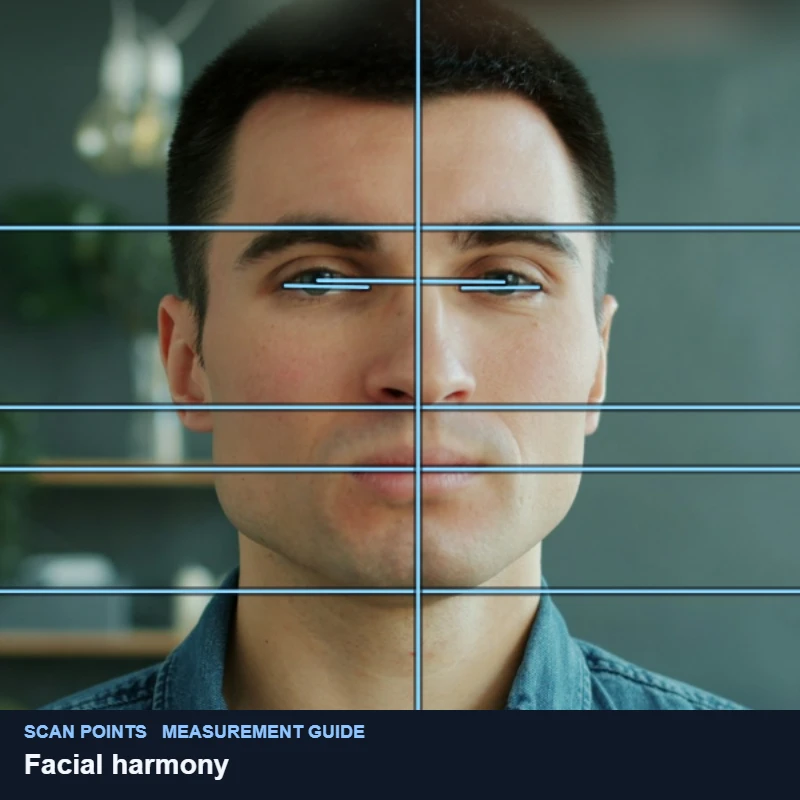
Condition and facial hair do the rest. Hair in good condition reflects light evenly and reads dense; dry, flat hair shows scalp. A beard shifts weight to the lower third and changes the balance the upper third is judged against. These are the traits the plan puts first for a receded hairline, because they change the next scan rather than the one a year away, and because none of them needs a prescription.
See which of the five hair traits is costing you points before you commit to a year of anything.
Questions
Does BecomeTen assign a Norwood number from the photo?
No. A frontal photo cannot see the crown, and the Norwood scale describes the whole scalp, so any number would be a guess. The report gives a hairline band and a density band for what the camera can actually see, tagged workable, with the evidence level of each step in the plan. If you want a clinical Norwood stage, a dermatologist can give one from a full examination.
Can a receded hairline still score well on the hair area?
Yes. Hairline is one of five hair traits, and condition, style fit and facial hair carry real weight. A stage-three recession with a cut that suits it, hair in good condition and a beard that balances the lower third can outscore a fuller hairline that is dry, flat and badly framed. The hairline band will still read as receded; the area score combines all five.
Does a receding hairline lower the harmony score or only the hair score?
Mostly the hair score, but the upper third is part of how proportion reads, so a hairline that has moved well up the forehead can nudge the harmony area too. That is a framing effect, not a change in bone, and a cut that lowers the visible start of the hair moves it back. The report tags it as workable for exactly that reason.
Will a shorter haircut make thinning hair read worse in a scan?
Usually the opposite. Very short hair shows the scalp evenly, so the contrast between full and thin zones drops and diffuse thinning reads as a deliberate style. Long hair combed over thin areas shows every gap under frontal light and often reads sparser. The exception is a sharp recession at the temples, which a very short cut exposes fully; a barber can shape around it.
Sources
- 1.A randomized clinical trial of 5% topical minoxidil versus 2% topical minoxidil and placebo in the treatment of androgenetic alopecia in men — Journal of the American Academy of Dermatology (2002)(Opens in a new window)
- 2.Finasteride in the treatment of men with androgenetic alopecia — Journal of the American Academy of Dermatology (1998)(Opens in a new window)
- 3.Ketoconazole shampoo: effect of long-term use in androgenic alopecia — Dermatology (1998)(Opens in a new window)
- 4.Low-level laser (light) therapy (LLLT) for treatment of hair loss — Lasers in Surgery and Medicine (2014)(Opens in a new window)
- 5.A randomized evaluator blinded study of effect of microneedling in androgenetic alopecia: a pilot study — International Journal of Trichology (2013)(Opens in a new window)