Tool · Harmony
Golden ratio face calculator
This golden ratio face calculator measures four proportions on your photo, in your browser, and shows how close each sits to 1.618. It is a curiosity, not a verdict: the perception research reviewed in 2006 and 2011 supports averageness, symmetry and skin condition, and no study has shown that faces closer to phi are rated more attractive.
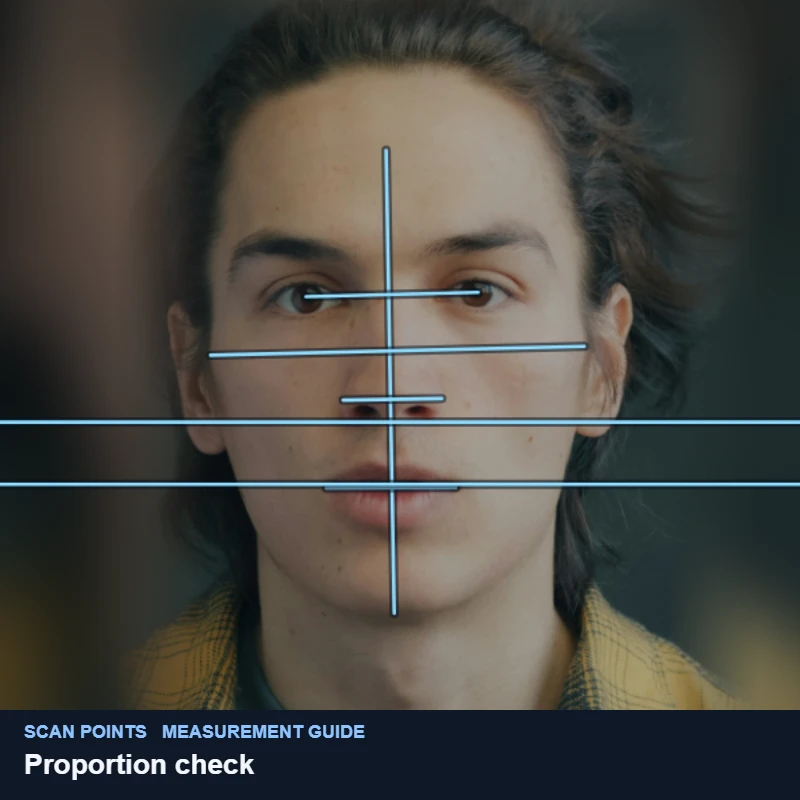
Example result
The proportions the golden ratio calculator checks, on a demo portrait. Scan guides are enlarged here so you can see what the tool reads.
Golden ratio face test
- Even light
- Neutral expression
- Phone at eye level
- Clean background
- Even lightFace a window. No harsh shadows from above.
- Neutral expressionNo smile, no makeup. Hair off your forehead.
- Phone at eye levelShoulders to top of head. Chin neither up nor down — angle can fake a sharper jaw.
- Clean backgroundPlain wall or neutral space.
Embed this test on your siteFree, no sign-up
Paste this where you want the golden ratio face calculator to appear: a blog post, a forum signature page, a barber's or clinic's site. It runs in your visitor's browser and never uploads their photo, so there is nothing to add to your privacy policy for it.
What does the golden ratio calculator compare?
The golden ratio, phi, is roughly 1.618. The claim, popular since a 1990s cosmetic-surgery marketing mask, is that faces whose proportions approach phi are more beautiful. The tool tests four of the commonly quoted proportions on your photo: face length to face width; the distance between the pupils to the width of the mouth; mouth width to nose width; and the distance from the base of the nose to the chin against the distance from the lips to the chin. It reads each pair from the face mesh, divides one by the other and shows how far the result sits from 1.618, above or below.
The mesh, the division and the comparison all run on your device. Nothing is sent to a server, and the photo is discarded when you close the page. What you get is four ratios and an overall closeness figure, which is exactly what every other golden-ratio calculator gives you, minus the claim that it means anything.
How to take the photo for the ratios
- Camera at eye level, an arm's length or more away. The face length to width ratio is the one most distorted by a close lens, which enlarges the centre of the face and narrows the sides.
- Face square to the lens. A turned head shortens the visible mouth and shifts the nose width.
- Hair off the forehead. Face length runs from the top of the forehead to the chin, so hair off the forehead lets the mesh sit on skin.
- Neutral mouth, closed. Mouth width changes with the slightest smile, and mouth width sits in one ratio.
- Even front light. Shadows move edges, and edges are what the mesh reads.
How to read a golden ratio result
Each ratio is shown with its distance from phi, and the four are combined into a single closeness percentage. A high closeness means your proportions happen to sit near 1.618 on this photo. A lower closeness means they do not, which describes most faces the research has ever rated as attractive. Read it the way you would read a horoscope you enjoy: as a description, not an instruction.
If the ratios themselves interest you, the facial ratios tool shows the proportions BecomeTen actually rates, thirds, fifths, width-to-height and midface, each explained against what the evidence says. Those are still photo estimates, but they are the proportions that perception studies have at least looked at.
Does the golden ratio predict facial attractiveness?
No, as far as the peer-reviewed literature goes. The 2006 review of the evolutionary psychology of facial beauty and the 2011 review in Philosophical Transactions of the Royal Society B both go through what has been shown to move attractiveness ratings: averageness, symmetry, sexual dimorphism, skin colour and texture, and cues to health and age. Neither finds a golden-ratio effect, and neither treats phi as a variable worth a section. The 1994 study that measured symmetry and averageness in photographed faces found averageness mattered on its own, which points the other way: a face close to the population mean is rated well, and the population mean is not built on phi.
Why does the idea persist? Because a mask overlaid on a famous face looks convincing, and because a single number is satisfying. Neither is evidence. BecomeTen's methodology lists what the rating weights and cites a study for each, and phi is not on the list.
What the calculator cannot tell you
It cannot measure your face. Every ratio here is read from a flat image, and the endpoints move with head pose, lens distance and light. The top of the forehead in particular is the edge of the mesh, not a fixed landmark, and a fringe can move it. Two photos of the same person taken at different distances will give different closeness figures, and neither is more true than the other.
It also cannot tell you what to change. The proportions it reads sit on bone: the length of the face, the width between the cheekbones, the position of the eyes. Bone does not move with exercise, posture or any routine, and BecomeTen does not recommend surgery at any tier. What is workable around those proportions is hair, brows, skin and body fat, which is where a plan built from the full rating starts.
Questions
Why does BecomeTen offer a golden ratio calculator if the research does not support it?
Because people search for one, and the honest version is better than the flattering one. The tool shows the ratios anyone else would show, on your device, and puts the evidence next to them. Someone who arrives wanting a phi score leaves knowing what the reviews found, which is more useful than a mask with a number on it.
Is a high golden ratio closeness the same as a high face rating?
No. The two are built on different things. Closeness to phi is four divisions on one photo. A BecomeTen rating weights averageness, symmetry, skin, eye area, jaw and hair against a fixed rubric, and phi is given no weight. Faces with ordinary ratios routinely rate well, and faces near phi routinely rate as average.
Which famous faces fit the golden ratio?
The lists that circulate were made by overlaying a mask on portraits chosen to fit it, and the endpoints were placed by hand. Redo the exercise with a different photo of the same person and the fit changes. No controlled study has picked faces by phi and found them rated more attractive, so the lists are a demonstration of the mask, not of the faces.
Should I try to change my face toward the golden ratio?
No. The ratios sit on bone, nothing non-surgical moves bone, and BecomeTen does not recommend surgery. More to the point, there is no evidence that moving toward phi would change how you are rated. The levers the research supports are skin, sleep, body fat, grooming and hair, and those are what a plan is built from.
Sources
- 1.The evolutionary psychology of facial beauty — Annual Review of Psychology (2006)(Opens in a new window)
- 2.Facial attractiveness: evolutionary based research — Philosophical Transactions of the Royal Society B (2011)(Opens in a new window)
- 3.Human (Homo sapiens) facial attractiveness and sexual selection: the role of symmetry and averageness — Journal of Comparative Psychology (1994)(Opens in a new window)