Tool · Harmony
Face symmetry test
This face symmetry test runs in your browser and reports how closely the left and right halves of your face mirror each other, as a percentage. It pairs landmarks across the midline, eyes, brows, cheeks, mouth corners and jaw, and compares their positions. Every face is somewhat asymmetric; the number is a photo estimate, and head pose moves it.
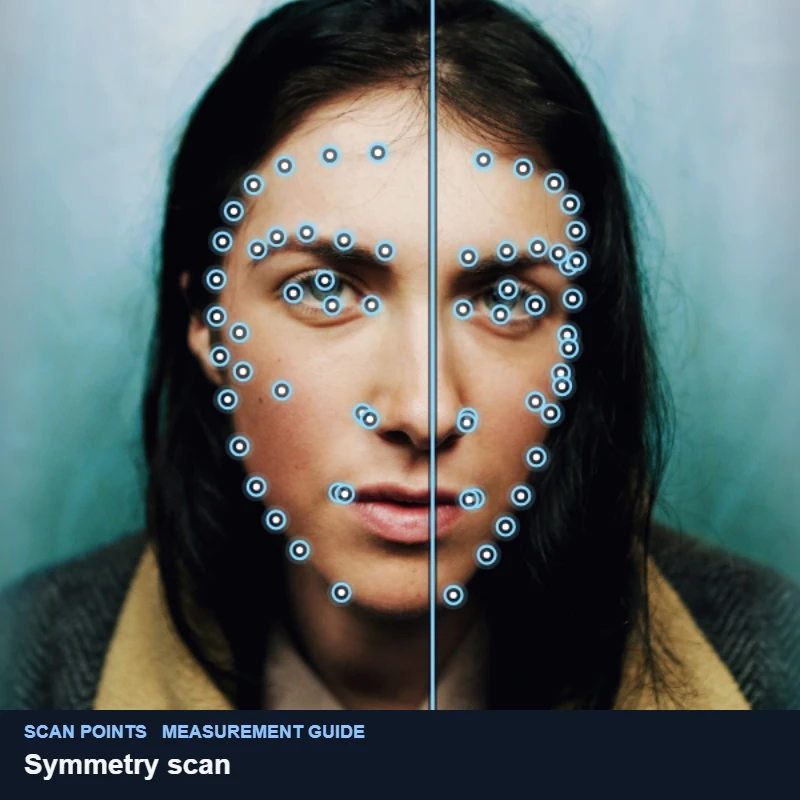
Example result
The mirrored landmark pairs the symmetry test compares, on a demo portrait. Scan guides are enlarged here so you can see what the tool reads.
Face symmetry test
- Even light
- Neutral expression
- Phone at eye level
- Clean background
- Even lightFace a window. No harsh shadows from above.
- Neutral expressionNo smile, no makeup. Hair off your forehead.
- Phone at eye levelShoulders to top of head. Chin neither up nor down — angle can fake a sharper jaw.
- Clean backgroundPlain wall or neutral space.
Embed this test on your siteFree, no sign-up
Paste this where you want the face symmetry test to appear: a blog post, a forum signature page, a barber's or clinic's site. It runs in your visitor's browser and never uploads their photo, so there is nothing to add to your privacy policy for it.
What does the face symmetry test compare?
The tool places a dense mesh of landmarks on the face, in the browser, and draws a midline through the top of the forehead and the centre of the chin. Then it takes pairs of matching points, the two inner eye corners, the two outer corners, the two brow peaks, the two cheek edges, the two mouth corners, the two jaw angles, mirrors one side across the midline and measures how far each mirrored point lands from its partner. Small distances mean the halves match well; larger ones mean one side sits higher, wider or further out than the other. The distances are averaged and turned into a percentage, where a higher number means the halves match more closely.
Nothing is sent anywhere. The mesh, the mirroring and the arithmetic all run on your device, and the photo is gone when you leave the page. The number you see is the whole output; there is no stored copy to compare later, which is one reason the full rating exists.
How to take the photo for a symmetry reading
Symmetry is the most camera-sensitive thing on this site. A head turned slightly makes the near half larger; a head rolled makes one eye higher; a lens too close stretches the centre. Each of those adds more asymmetry than most people actually have. The tool undoes the first two itself: the face mesh carries depth, so it rotates a slightly turned head back to frontal and levels a rolled one before comparing the halves. It cannot undo a close lens or side light, so the photo still matters more here than anywhere else.
- Face the lens square, chin level. Line your ears up equally in the preview. If one ear shows more than the other, you are turned.
- Camera at eye level. Above or below eye level tilts the whole face and skews the midline.
- Arm's length or further. Close lenses stretch the nose and shrink the sides unevenly.
- Flat, even light from the front. A window on one side shadows one cheek, and the shadowed edge reads narrower.
- Neutral face, rested. Most people smile more on one side, and a short night puffs one eye more than the other.
- Centre parting, or hair fully back. A side parting drags the visual midline and can shift where the tool finds it.
How to read your symmetry percentage
Read the number as a band, not as a fact about your skeleton. A result in the upper range means the mirrored points landed close to their partners and the face reads balanced. A result in the middle means one or two pairs sit noticeably apart, often one brow higher or the jaw a little to one side, and the tool shows which. A result in the lower range usually means either a real, visible lean or a photo taken off-axis, and you should retake before deciding which. No living face scores at the very top, and no living face needs to.
Compare only against yourself, on photos taken the same way. Two symmetry calculators on the same photo will disagree, because they choose different landmark pairs, different midlines and different ways of averaging. A percentage from this tool is not comparable with a percentage from another site, and neither is comparable with a friend's.
What a symmetry percentage cannot tell you
It cannot separate bone from posture. The tool sees where the landmarks are in the picture; it does not know whether one jaw angle sits lower because the mandible does, or because the head was rolled a fraction, or because a swollen cheek moved the edge. That is why the full BecomeTen report gives facial symmetry as a band with a capture grade instead of a decimal. A decimal read off a selfie is reporting camera noise as anatomy, and this page says so next to its own number.
It also cannot tell you how attractive you are. Symmetry is a real input to attractiveness ratings, but a modest one. The 1994 study that measured symmetry and averageness in photographed faces found both correlated with ratings, and the 2011 review found averageness the stronger of the two, with symmetry partly explained by it. Faces built by mirroring one half look wrong to raters. Balanced is the target; perfect is not.
Is facial symmetry structural or workable?
Mostly structural. Where the orbits, cheekbones and jaw sit is bone, and nothing non-surgical moves bone. Chewing on one side, sleeping on the other, face yoga and symmetry massage do not relocate a jaw, and BecomeTen does not recommend surgery at any tier. What is workable is the soft-tissue layer and the framing: brows groomed to the same height, a parting that does not drag the midline, swelling from sleep and salt, and the way the photo is taken. Those can honestly move a face from one band into the neighbouring one, because soft tissue was the part reading lopsided.
Questions
What is a normal face symmetry percentage?
There is no reference table, because the number depends on the tool. On this one, most well-taken photos of ordinary faces land in the upper part of the range with a few pairs slightly apart, which is the ordinary state of a human face. Treat anything outside that as a prompt to retake the photo square-on before reading it as anatomy.
Why did my symmetry percentage change between two photos taken minutes apart?
Because the camera moved, not your face. The tool corrects a small turn or roll itself, but a phone held a little higher or closer, or light from a different side, still shifts landmark pairs by more than most real asymmetry. Repeat the photo at arm's length with the lens at eye level and even light, and the two numbers will sit much closer.
Can I improve my face symmetry test result without surgery?
You can improve the reading, not the bone. Matched brows, a centre parting, a rested face and a square-on photo remove the soft-tissue and camera asymmetry that sits on top of the skeletal kind. If the remaining lean is bone, no exercise, chewing pattern or massage moves it, and BecomeTen does not recommend a procedure to do so.
Is the mirrored half-face image a symmetry test?
No. The two faces built from your left half and your right half look odd because a face that is perfectly mirrored is not what raters find attractive. They show that you are asymmetric, which every face is, and nothing about how much. The percentage on this page and the band in the report are the honest versions of that picture.
Sources
- 1.Human (Homo sapiens) facial attractiveness and sexual selection: the role of symmetry and averageness — Journal of Comparative Psychology (1994)(Opens in a new window)
- 2.Facial attractiveness: evolutionary based research — Philosophical Transactions of the Royal Society B (2011)(Opens in a new window)