Tool · Harmony
Facial ratio calculator: thirds, fifths, fWHR, midface
This facial ratio calculator reads four proportions from one photo, in your browser: the vertical thirds, the horizontal fifths, the facial width-to-height ratio and the midface ratio. Each is reported as a band, longer or shorter, wider or narrower, against the balanced case. They are photo estimates, not measurements, and the bone that sets them is structural.
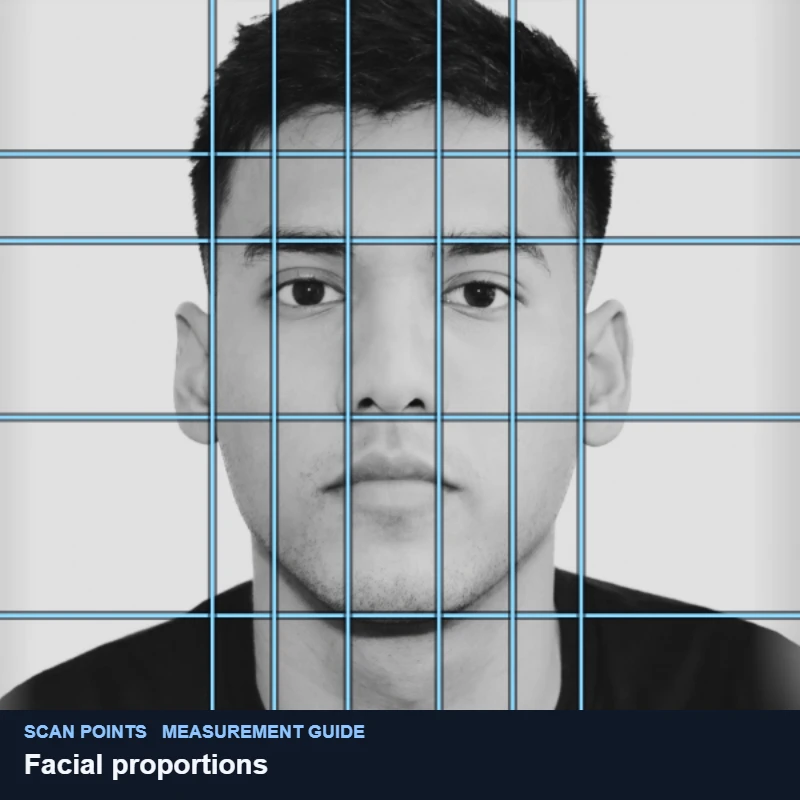
Example result
The thirds, fifths and width lines the facial ratio calculator measures, on a demo portrait. Scan guides are enlarged here so you can see what the tool reads.
Facial proportions calculator
- Even light
- Neutral expression
- Phone at eye level
- Clean background
- Even lightFace a window. No harsh shadows from above.
- Neutral expressionNo smile, no makeup. Hair off your forehead.
- Phone at eye levelShoulders to top of head. Chin neither up nor down — angle can fake a sharper jaw.
- Clean backgroundPlain wall or neutral space.
Embed this test on your siteFree, no sign-up
Paste this where you want the facial ratio calculator: thirds, fifths, fwhr, midface to appear: a blog post, a forum signature page, a barber's or clinic's site. It runs in your visitor's browser and never uploads their photo, so there is nothing to add to your privacy policy for it.
What does the facial ratio calculator read?
Harmony, in a face rating, is mostly proportion: how the parts of the face divide its height and width. The tool runs a face mesh on your photo and reads the four proportions that come up most often, in forums and in the research. Everything happens on your device, and the photo is discarded when you close the page.
| Proportion | What is compared | Bands |
|---|---|---|
| Facial thirds | Top of the forehead mesh to brow, brow to base of nose, base of nose to chin | Whether the middle or the lower third runs long |
| Facial fifths | Face width divided into five eye-widths; the eyes, the gap between them and the outer fifths | Eyes close-set, balanced or wide-set |
| fWHR | Cheekbone width divided by the height from the upper eyelids to the top of the upper lip | Wider midface, typical (about 1.7–2.2 on this tool) or narrower midface |
| Midface ratio | Distance between the pupils against the height from pupils to upper lip | Longer, balanced or shorter midface |
Each proportion has its own glossary entry with the research behind it: facial thirds, facial fifths, fWHR and the midface ratio. The tool shows all four at once on the same photo so you can see which ones lean and which sit balanced.
How to take the photo for facial proportions
Every one of these ratios is a distance divided by another distance, and each distance is read off a flat image. Anything that stretches one and not the other changes the ratio. The rules remove the known distortions.
- Camera at eye level, face square. A camera above shortens the lower third and lengthens the upper; a camera below does the reverse. A turned head shrinks one outer fifth.
- Arm's length or further. A close lens enlarges the nose and the centre of the face and narrows the sides, which throws the fifths and fWHR at once.
- Hair fully off the forehead. The top endpoint is the top of the forehead mesh, not the hairline, so only the middle and lower thirds are banded; hair off the forehead keeps the mesh on skin.
- Brows relaxed. Raised brows lengthen the upper third and shorten the fWHR height leg.
- Neutral mouth, even front light. Edges move under side light, and the mesh reads edges.
How to read the four bands
Balanced is the ordinary case and the one the research rewards, because a face close to the population average is what averageness means. A band that leans is a description, not a fault. A long lower third often means a tall chin or a long jaw. The upper third is not banded, because the face mesh stops below the hairline. Close-set or wide-set eyes describe the fifths; neither is rated lower on its own. A wider fWHR reads as a broad midface, which the literature links more to perceived dominance than to attractiveness. A longer midface reads as more distance between the eyes and the mouth, which the forums dislike and the research is quiet on.
Look for agreement between bands. If the thirds say a long lower third and the midface ratio says balanced, the length is in the chin and jaw. If the fWHR says narrower on a photo taken close to the lens, retake it from further away before you believe it. The four together tell you more than any one does, and the full rating reads them as a set.
What the calculator cannot tell you
It cannot produce a measurement. A photo is a projection, and the endpoints of every distance here move with head pose, lens distance, light and hair. The top of the forehead in particular is the edge of the mesh, not the hairline, which is why the upper third is not banded. Two honest photos can land a proportion in neighbouring bands. The free tool prints the readings under the bands so you can compare two of your own photos; the methodology keeps ratio values out of the full rating for exactly that reason.
It cannot tell you that equal thirds or five equal fifths are a law of beauty. Those rules come from art instruction, not from perception studies. What the 2006 and 2011 reviews of facial attractiveness support is averageness, symmetry, sexual dimorphism and skin, and a face near the average happens to sit near the textbook proportions because that is what average looks like. The 2010 study of visual cues to weight found width measures track perceived weight, so fWHR is partly a fat cue, which is the one proportion here with a workable component.
Are facial proportions structural or workable?
Structural, almost entirely. The thirds are set by the skull, the maxilla and the mandible. The fifths are set by the orbits. fWHR is set by the zygomatic arches and the maxilla. The midface ratio is set by the same bones. None of it moves with mewing, chewing, posture or any routine, and BecomeTen does not recommend surgery at any tier. All four bands are tagged structural in the report, and the potential image is forbidden from redrawing them.
The workable part is small but real. Cheek fat adds width over the arches, so the apparent fWHR rises and falls with body fat. Hair at the temples adds width; a fringe hides the upper third; a beard lengthens the lower third. Brow grooming moves the top of the middle third. These change how the proportions read, not the bone, and they are the levers a plan is allowed to use. The face shape tool reads the outline the same proportions sit inside.
Questions
Which of the four facial ratios matters most for a face rating?
None dominates. In the full rating they are four of eight harmony traits and are weighted modestly, because the evidence for any single proportion is thin. What moves ratings in the reviews is averageness as a whole, and a face that sits balanced on most of them is close to that. One leaning band on an otherwise balanced face costs little.
Why read the bands rather than the decimals?
Because a value read off one photo carries false precision. The endpoints move with camera height, lens distance, hair and expression by more than most faces differ from each other, so the decimals mostly help you compare two of your own photos taken the same way. A band is the resolution a photo can carry, and the full report follows the same rule for every structural trait.
Can I fix a long midface or uneven thirds?
Not the bone. The maxilla, orbits and mandible set these proportions and nothing non-surgical moves them; BecomeTen does not recommend surgery. You can change how they read: hair to balance the upper third, brow grooming, a beard for the lower third, and body fat for width. The report tags each lever with its evidence level.
Do my facial fifths and my interpupillary distance measure the same thing?
They overlap. The middle fifth is the gap between the inner eye corners, and the interpupillary distance is the gap between the pupil centres, so both describe eye spacing. The fifths compare that gap with the rest of the face; the pupillary distance tool gives it as a standalone estimate, mainly for glasses. Neither is rated as better or worse on its own.
Sources
- 1.The evolutionary psychology of facial beauty — Annual Review of Psychology (2006)(Opens in a new window)
- 2.Facial attractiveness: evolutionary based research — Philosophical Transactions of the Royal Society B (2011)(Opens in a new window)
- 3.Deciphering faces: quantifiable visual cues to weight — Perception (2010)(Opens in a new window)