Tool · Eye area
Pupillary distance from a photo
This tool estimates your pupillary distance, the gap between the centres of your pupils, from one photo in your browser. It finds both pupils, then scales the gap using the width of your iris, which varies very little between adults. The result is an estimate for ordering glasses online; an optician's measurement is the one to trust.
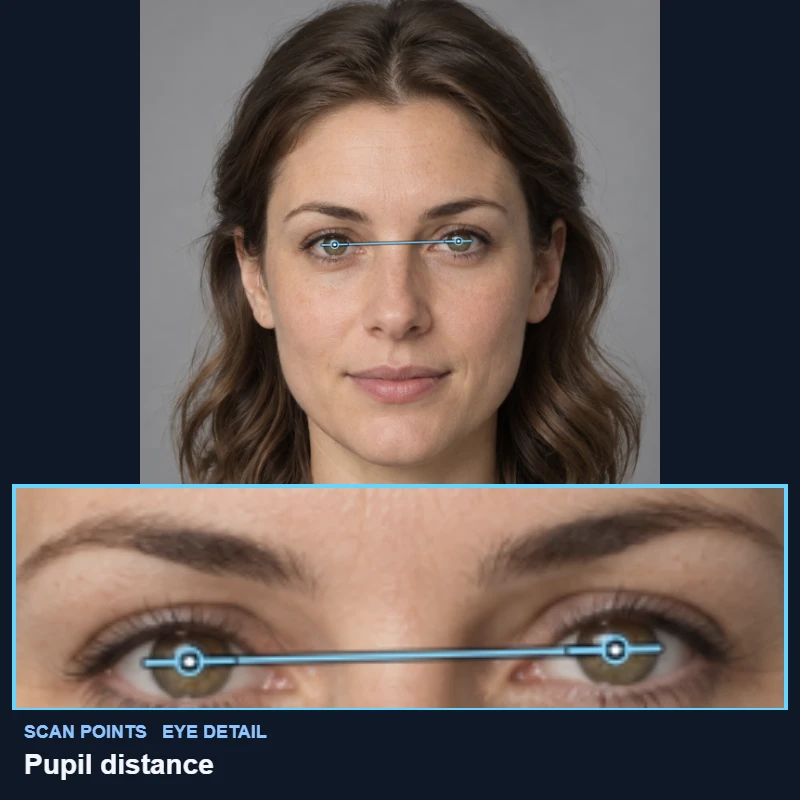
Example result
The pupil centres the pupillary distance estimate measures between, on a demo portrait. Scan guides are enlarged here so you can see what the tool reads.
Pupillary distance measurement
- Even light
- Neutral expression
- Phone at eye level
- Clean background
- Even lightFace a window. No harsh shadows from above.
- Neutral expressionNo smile, no makeup. Hair off your forehead.
- Phone at eye levelShoulders to top of head. Chin neither up nor down — angle can fake a sharper jaw.
- Clean backgroundPlain wall or neutral space.
Embed this test on your siteFree, no sign-up
Paste this where you want the pupillary distance from a photo to appear: a blog post, a forum signature page, a barber's or clinic's site. It runs in your visitor's browser and never uploads their photo, so there is nothing to add to your privacy policy for it.
What does the pupillary distance tool measure?
Pupillary distance, PD, is the distance between the centres of the two pupils when you look straight ahead. Glasses need it so that the optical centre of each lens sits in front of the eye; a lens centred in the wrong place adds unwanted prism and makes the world swim slightly at the edges. Opticians measure it with a ruler or a pupillometer. This tool estimates it from a photo, which is what the online eyewear order form is asking you for.
The problem with a photo is scale. Pixels are not millimetres, and the tool has no idea how far away the camera was. The usual fix is a credit card held to the forehead as a reference object. This tool uses a reference you already carry: the iris. The visible width of the adult iris varies remarkably little from person to person, so the tool finds the edge of each iris, uses its width to work out how many pixels one unit of real distance covers in this photo, and applies that scale to the gap between the pupil centres. The face mesh, the iris fit and the scaling all run on your device; nothing is sent anywhere.
How to take the photo for a PD estimate
Two things decide whether the estimate is useful: whether the iris edges are sharp enough to fit, and whether you were looking straight at the lens. The rules follow from those.
- Look straight at the lens, both eyes open normally. Looking at the screen instead of the camera converges the eyes slightly and shortens the gap. PD for distance glasses is the straight-ahead figure.
- Camera at eye level, face square, arm's length away. A turned head foreshortens one side; a close lens bends the outer eye.
- Sharp focus on the eyes, even front light. The iris edge must be visible against the white. Blur, shadow across the eye, or a light reflected over the iris edge all spoil the fit.
- No glasses, no contact lenses with a coloured ring. Frames refract the eye position; coloured lenses redraw the iris edge.
- Use the rear camera with a timer if you can. It is sharper than the front camera and less prone to the wide-lens stretch.
How to read the result
The tool reports a single figure for the distance between the pupil centres and the likely range around it. If the photo check under the result flags the light, the angle or the distance, retake rather than trusting the number. If it is good, treat the figure as a starting point that is likely to be within a small margin of what an optician would measure, which is enough for a single-vision online order in most cases and not enough for progressive lenses, where the fitting is more sensitive.
Some order forms ask for a separate figure for each eye rather than the total. Faces are asymmetric, and the two halves of the PD are rarely identical. The tool reports the total; if the form wants halves, a fair working answer is to split the total evenly, and the honest one is to ask the optician who last examined you. Most will give the figure from your record if you ask.
What the tool cannot tell you
It cannot replace a measurement. The iris is a good reference because it varies little, but it does vary, and the fit to its edge is only as good as the photo. Focus, light, gaze direction and lens distortion each move the estimate by a little, and they can add up. BecomeTen makes the same point on every page: a photo gives an estimate, not a measurement, and the interpupillary distance entry explains why the full rating reports eye spacing as a band rather than a figure.
It cannot tell you your near PD. Reading glasses and the near portion of progressives use a smaller figure, because the eyes converge on a close object, and that is measured differently. It also cannot tell you anything about how your eye spacing looks; that is the job of the facial fifths and the eye spacing test, and no spacing is rated better or worse on its own.
Is pupillary distance structural?
Entirely. The pupils sit in the orbits, the orbits sit in the skull, and the gap is fixed in adulthood. It does not move with any routine, and there is no reason to want it to. Unlike most of the traits on this site, PD is not something the forums argue about; it is a number for glasses, and this page treats it as one. The only workable thing about it is the frame you put around it, which glasses by face shape covers.
Questions
How accurate is a pupillary distance measured from a photo?
Good enough for a single-vision online order when the photo is sharp, front-lit and taken looking straight at the lens, and not good enough for progressives or strong prescriptions. The iris reference removes most of the scale error, but focus, gaze and lens distortion still add a small margin. Confirm with an optician if the order matters.
Why does the PD tool use my iris instead of a credit card?
Because the iris is already in the photo, at the same distance as the pupils, and its visible width varies very little between adults. A card held to the forehead sits in a different plane from the eyes and is often tilted, which introduces its own error. The iris is a smaller reference, so the photo needs to be sharp, but it is a better-placed one.
Is my PD different for reading glasses?
Yes. When you look at something close the eyes converge, so the near PD is a little smaller than the distance PD. This tool estimates the distance figure, which is what single-vision distance glasses need. Reading glasses and progressives use the near figure or both, and those should come from an in-person fitting.
Does a wide or narrow pupillary distance say anything about my face rating?
Not on its own. Eye spacing is one of the harmony traits in the full rating, read as a band within the facial fifths, and neither close-set nor wide-set is rated lower by itself; what matters is how it sits with the rest of the face. The figure from this page is for glasses, and no one should read it as a score.