Tool · Eye area
Eye shape test
This eye shape test finds your eye shape from one photo, in your browser. It reads how long each eye opening is compared with how tall, and which way the outer corner slopes, then names both: an opening (almond, round or narrow) and a tilt (upturned, slightly lifted, level or downturned). The result is a photo estimate; head pose and expression both move it.
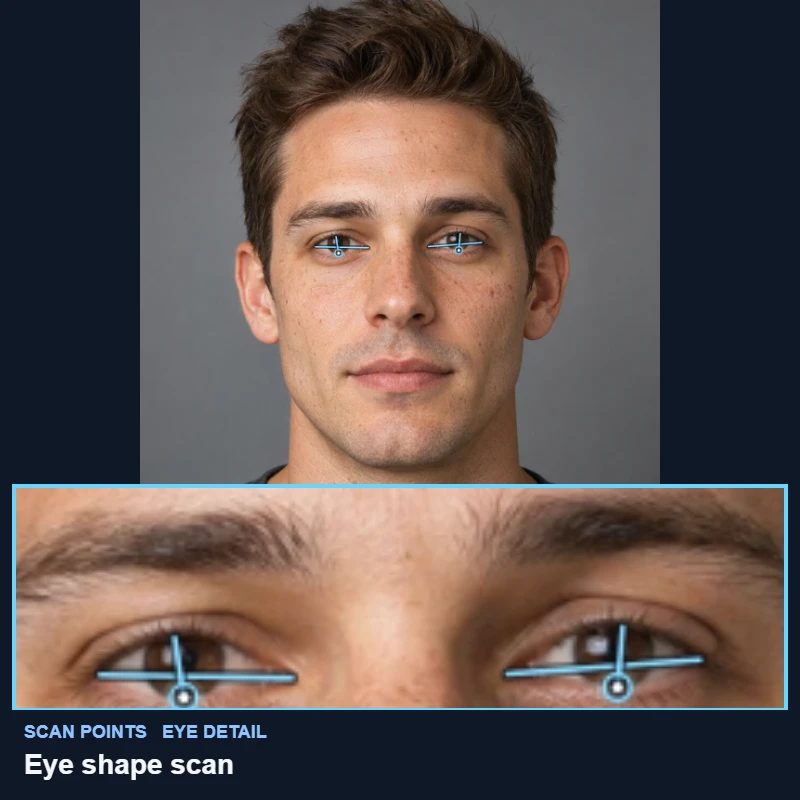
Example result
The eye outline the eye shape test reads, on a demo portrait. Scan guides are enlarged here so you can see what the tool reads.
Eye shape detector
- Even light
- Neutral expression
- Phone at eye level
- Clean background
- Even lightFace a window. No harsh shadows from above.
- Neutral expressionNo smile, no makeup. Hair off your forehead.
- Phone at eye levelShoulders to top of head. Chin neither up nor down — angle can fake a sharper jaw.
- Clean backgroundPlain wall or neutral space.
Embed this test on your siteFree, no sign-up
Paste this where you want the eye shape test to appear: a blog post, a forum signature page, a barber's or clinic's site. It runs in your visitor's browser and never uploads their photo, so there is nothing to add to your privacy policy for it.
What does the eye shape test read?
Eye shape, as the term is used in makeup guides and forums, comes down to two proportions of the eye opening, the palpebral fissure. The first is its length against its height: a long, low opening reads almond or narrow; a shorter, taller one reads round. The second is the slope from the inner corner to the outer: outer corner higher reads upturned, lower reads downturned. The tool places a face mesh on the photo, in your browser, finds the corners and the top and bottom of each lid, and computes both proportions for each eye, then averages the two eyes and names the opening and the tilt that sit closest. Nothing leaves your device.
| Name | Part of the result | What decides it |
|---|---|---|
| Almond | Opening | Typical length relative to height, tapered corners |
| Round | Opening | Short relative to height; more of the iris circle shows |
| Narrow | Opening | Very long relative to height; little lid shows |
| Upturned | Tilt | Clearly positive |
| Slightly lifted | Tilt | Slightly positive, the most common reading |
| Level | Tilt | Neutral |
| Downturned | Tilt | Negative |
The length proportion is the trait the glossary calls palpebral fissure length; the slope is canthal tilt. The tool bundles them into a name because that is what people search for, and shows the two bands underneath because the bands are the honest part.
How to take the photo for an eye shape reading
- Camera at eye level, looking straight at the lens. Looking up opens the lids and makes the opening read rounder; looking down hoods the lids and narrows it; a camera above or below does the same.
- Head straight, facing the lens. The tool levels a head tipped toward one shoulder before it measures, but a turned head shifts the corners and lowers the confidence of the result.
- Eyes open normally. Not wide, not squinting. A deliberate wide-eye pose makes any eye read round.
- Brows relaxed, no smile. A smile lifts the cheeks and pushes the lower lid up, which shortens the opening's height.
- Rested, no makeup. Eyeliner and lashes redraw the corners the mesh reads, and puffy lower lids fill the outer corner.
- Arm's length or further, even front light. Close lenses stretch the centre of the face and move the inner corners.
How to read an eye shape result
The result names one shape for both eyes and shows the two bands behind it: the opening band, narrower, typical or rounder, and the tilt band, positive, slightly positive, neutral or negative. Read the bands first. Most eyes are almond by the tool's definition, because almond is the middle of the opening range, and most adults tilt slightly upward, which the tool calls slightly lifted rather than upturned. If you suspect your two eyes differ, the canthal tilt test shows a band for each eye. If the name surprises you, look at which band pushed it: a round result on an eye you think of as almond is almost always the height reading, and the height reading is the one most affected by expression and by looking slightly up.
No shape is scored. The full rating does not have an eye shape trait; it has seven eye-area traits, of which fissure length and tilt are two, each reported as a band with a workable or structural tag. Shape names are for choosing eyeliner and brow grooming, and for knowing what the forums mean when they say hunter eyes.
What the test cannot tell you
It cannot measure the eye. The fissure's length and height are read from a flat image, and both move with head pose, gaze direction, lid tension and how rested you are. The names are bins drawn over two continuous ranges, and a face can honestly land in two bins on two photos taken minutes apart. For that reason the full rating, under the methodology, does not report a fissure length as a number, and this page reads bands.
It cannot tell you which shape is better. The 2011 review of attractiveness research supports averageness, symmetry and sex-typical features; there is no almond-eye rule in it, and no evidence that round or downturned eyes are rated lower on their own. A larger eye area reads more feminine and a deeper-set, narrower one more masculine, which is a sex-typical cue, not a ranking of shapes.
Is eye shape structural or workable?
The length of the opening and the slope of the corners are set by the orbit and the canthal ligaments. Those are bone and ligament, and nothing non-surgical moves them. BecomeTen tags both structural, the plan never promises to change them, and BecomeTen does not recommend surgery at any tier. Eye exercises and taping change nothing but eyelid skin.
The height of the opening has a workable component. How much the upper lid hoods and how much the lower lid puffs both change how tall the fissure reads, and both move with sleep, salt, allergies and age; a study photographing the same people rested and sleep-deprived found the tired faces judged to have more hanging eyelids and swollen eyes. Brow grooming changes where the lid appears to start. Makeup redraws the corners entirely, which is why the test asks for none. The lid trait with the most room is covered under upper eyelid exposure.
Questions
What is the most common eye shape on the test?
Almond, by a wide margin, because it sits in the middle of both proportions the tool reads and most eyes are near the middle. Round is the next most common, usually on eyes with a shorter opening or on photos taken looking slightly up. Clearly upturned or downturned results are less common and are worth confirming with a second photo.
Why does the eye shape test call my eyes round when I think they are almond?
Almost always the height reading. A photo taken looking slightly up, with the brows raised or with a hint of a smile, opens the lids and makes the fissure read taller, which tips almond to round. Retake at eye level, looking straight at the lens, with the face relaxed. If it still says round, the opening is shorter than it feels, which is fine.
Are almond eyes the most attractive eye shape?
There is no evidence for that. Almond is called ideal in makeup guides because most eyeliner techniques are designed for it, which is a statement about makeup. The attractiveness reviews support averageness, symmetry and sex-typical features, and almond is simply the average shape, so an almond result means ordinary rather than superior.
Can eyeliner or lash extensions change my eye shape result?
Yes, which is why the test asks for a bare eye. Liner extended past the outer corner moves where the mesh finds the corner and fakes both a longer fissure and a more positive tilt; lashes on the lower lid move the bottom edge. The result on a made-up eye describes the makeup, and it is the makeup working as intended.