Tool · Eye area
Eye spacing test
This eye spacing test measures the gap between your inner eye corners against the width of one eye, from one photo, in your browser. It reports close-set, balanced or wide-set, the ratio behind the band, and how far apart your pupils sit against your face width. Spacing is set by bone, and neither end is rated lower.
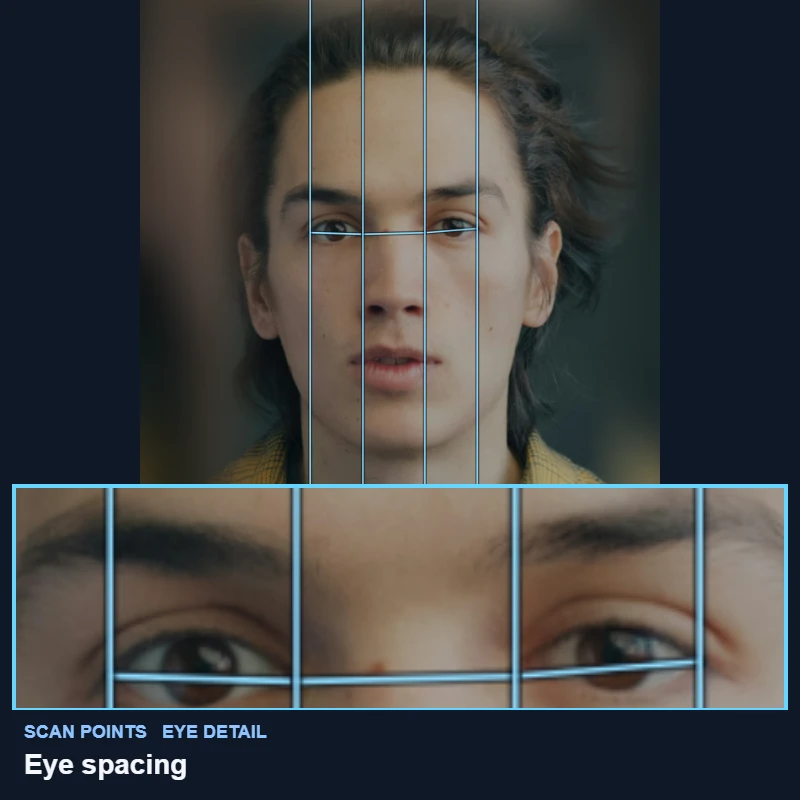
Example result
The eye widths and gap the eye spacing test compares, on a demo portrait. Scan guides are enlarged here so you can see what the tool reads.
Eye spacing test
- Even light
- Neutral expression
- Phone at eye level
- Clean background
- Even lightFace a window. No harsh shadows from above.
- Neutral expressionNo smile, no makeup. Hair off your forehead.
- Phone at eye levelShoulders to top of head. Chin neither up nor down — angle can fake a sharper jaw.
- Clean backgroundPlain wall or neutral space.
Embed this test on your siteFree, no sign-up
Paste this where you want the eye spacing test to appear: a blog post, a forum signature page, a barber's or clinic's site. It runs in your visitor's browser and never uploads their photo, so there is nothing to add to your privacy policy for it.
How is eye spacing measured?
The usual yardstick is the eye itself. In the drawing rule that divides the face width into five equal fifths, the gap between the eyes is one eye wide, and each eye is one fifth. Clinicians use the distance between the inner corners, the intercanthal distance, and compare it with the width of the eye opening, the palpebral fissure length. The facial fifths entry explains the rule and its limits.
This tool follows the clinical version. A face mesh runs on your photo on your device, finds the inner and outer corner of each eye, and divides the gap between the inner corners by the average eye width. It also reports the pupil-to-pupil distance as a share of the cheekbone width, which is how far apart the eyes look against the whole face.
| Band | What it means | How it tends to read |
|---|---|---|
| Close-set | Gap under about 1.07 eye widths | Focused, intense; the nose can look longer |
| Balanced | Gap about 1.07–1.28 eye widths, as the mesh places the corners | The ordinary case |
| Wide-set | Gap over about 1.28 eye widths | Open, youthful; common in models |
One calibration note. The mesh places the inner corners slightly toward the nose, at the fleshy corner rather than the fold, so a balanced face reads a little above one eye width on this tool. The bands are set from real photos run through the same mesh, not from the textbook fraction, so balanced here means ordinary.
Are wide-set or close-set eyes more attractive?
Neither, on its own. The research on facial attractiveness supports averageness, symmetry, sexual dimorphism and skin quality. Eye spacing matters through averageness: faces near the typical spacing are rated well, and small departures either way are barely noticed. Slightly wide-set eyes are common among fashion models and are often described as youthful; slightly close-set eyes are often described as intense. The forums treat both ends as flaws, which the evidence does not support.
How to take the photo for eye spacing
- Face square to the camera. A turn shrinks the far eye and the gap together, and the tool marks a turned head as low confidence.
- No glasses. Frames hide the corners and the lenses magnify or shrink the eyes.
- Eyes open and relaxed. A squint or a smile shortens the eye opening and makes the gap look wider.
- Arm's length, even front light. Shadows at the inner corners move where the mesh puts them.
Can eye spacing be changed?
No. The spacing is set by the orbits, the bony eye sockets, and nothing non-surgical moves them; BecomeTen does not recommend surgery. What changes how the spacing reads is framing. Brows that start closer to the nose make wide-set eyes read closer; brows that start further out do the opposite. Glasses frames with a narrow bridge pull the eyes together visually, and a wide bridge spreads them. Eye makeup concentrated at the inner or outer corners shifts the apparent spacing too.
Questions
What is the ideal eye spacing?
The drawing rule says the gap between the eyes equals one eye width, and real faces cluster around that. There is no ideal beyond it: faces near the typical spacing read as balanced, and moderate departures either way are rated about the same. Treat the band as a description, not a grade.
How can I tell if I have wide-set eyes without a tool?
Look straight into a mirror or a photo taken at eye level and compare the gap between the inner corners with the width of one eye. If a third eye would clearly fit with room to spare, the eyes are wide-set; if it clearly would not fit, they are close-set. The tool does the same comparison with landmarks.
Is eye spacing the same as pupillary distance?
They overlap but are not the same. Eye spacing compares the gap between the inner corners with the eye width, which is about proportion. Pupillary distance is the gap between the pupil centres as an absolute estimate, which matters for glasses. The two usually agree on whether eyes sit close or wide.