Tool · Eye area
Eye type test: almond, fox, siren, doe, hunter or prey
This eye type test reads three things from one photo, in your browser: how open your eyes are, how much they tilt upward, and how low your brows sit. It compares them with real frontal photos and names the closest type, almond, fox, siren, doe, hunter or prey, with the runner-up and the measurements behind the call.
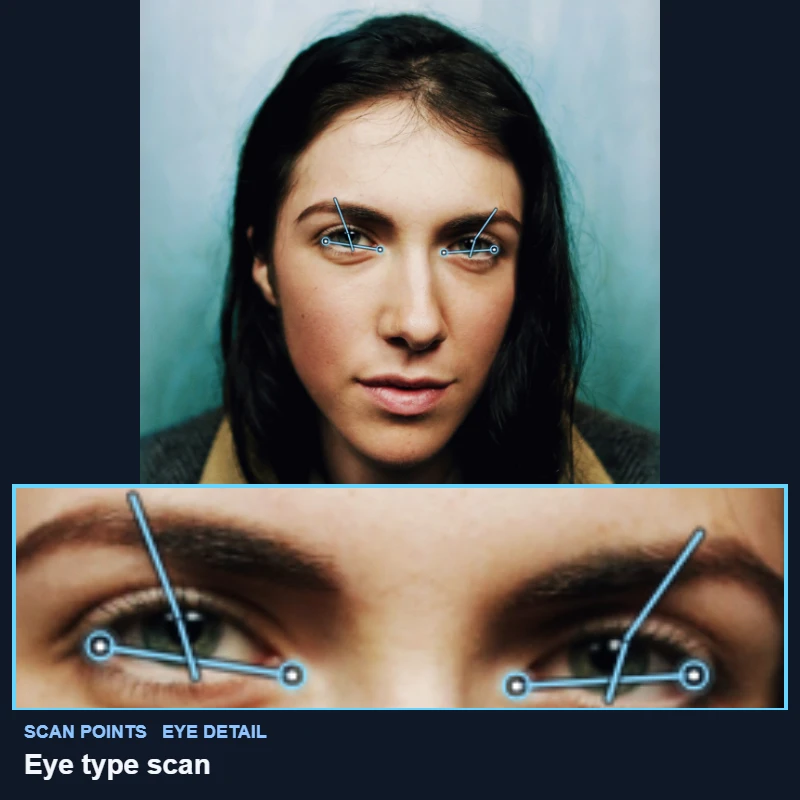
Example result
The eye points the eye type test classifies, on a demo portrait. Scan guides are enlarged here so you can see what the tool reads.
Eye type test
- Even light
- Neutral expression
- Phone at eye level
- Clean background
- Even lightFace a window. No harsh shadows from above.
- Neutral expressionNo smile, no makeup. Hair off your forehead.
- Phone at eye levelShoulders to top of head. Chin neither up nor down — angle can fake a sharper jaw.
- Clean backgroundPlain wall or neutral space.
Embed this test on your siteFree, no sign-up
Paste this where you want the eye type test: almond, fox, siren, doe, hunter or prey to appear: a blog post, a forum signature page, a barber's or clinic's site. It runs in your visitor's browser and never uploads their photo, so there is nothing to add to your privacy policy for it.
What are the eye types?
The eye types come from social media, not from anatomy. Each name describes a look that makeup artists and forums recognise, and each look comes down to the same three traits: the opening of the eye against its width, the canthal tilt from the inner to the outer corner, and the distance from the lid to the brow. The tool reads those three from a face mesh and names the pattern your eyes sit closest to.
| Type | Opening | Tilt | Brow |
|---|---|---|---|
| Almond | Average | Slightly upward, the common case | Average |
| Fox | Narrow and long | Strongly upward | Slightly low |
| Siren | Elongated | Upward | Average |
| Doe | Round and open | A little less lift than average | Slightly high |
| Hunter | Narrow | Upward | Low, close to the lid |
| Prey | Round | Level | High |
Each type has its own page with how to tell, what it looks like in photos and how makeup plays it up: fox eyes, siren eyes, doe eyes, prey eyes and the hunter eyes test. Almond is the average eye and the most common result.
How the eye type test works
A face mesh runs on your photo on your device and finds the corners, the lid margins and the brow above each eye. The tool averages the two eyes, then measures each trait against the typical value in real frontal photos run through the same mesh. The type is the pattern your three readings sit nearest to. If two types are almost as close, the result says so and names both, because real eyes often sit between labels. Nothing is uploaded, and the photo is gone when you close the page.
The measurements are shown with the result, so you can see why the call went the way it did: a narrow opening with a strong upward tilt reads fox, a round opening with a high brow reads doe or prey. The canthal tilt test and the eye shape detector read the tilt and the opening on their own if you want one number at a time.
How to take the photo for an eye type test
- Relaxed face, eyes open normally. A smile narrows the opening and lifts the lower lid; wide eyes do the reverse. Both change the type.
- Brows at rest. Raised brows turn hunter eyes into almond or prey in one photo.
- Camera at eye level, face square. A camera above the face makes the eyes look rounder and more upturned; one below turns the corners down.
- No glasses, no heavy eyeliner. Winged liner fakes a tilt; that is its purpose.
Does eye type affect attractiveness?
Less than the internet suggests. The research on facial attractiveness supports averageness, symmetry, sexual dimorphism and skin; the eye area matters through those, not through a named type. A slightly positive tilt is common and reads well, and the eye region carries a lot of the perceived age of a face, which is why tired eyes cost more than any type. The types are aesthetics and fashion. Every one of them appears on faces people rate highly.
The bone around the eye does not change with exercises, and BecomeTen does not recommend surgery for any eye type. What changes how the type reads is makeup, brow shape, lashes and sleep. The full rating reads the eye area as several traits, including tilt, eyelid exposure and under-eye condition, and separates what is workable from what is structural.
Questions
What is the most common eye type?
Almond. It is the average eye: a medium opening, a slight upward tilt and a brow at the usual height. Most faces land there or between almond and one neighbour, which is why the test names a runner-up. The more distinct types, fox, siren, doe, hunter and prey, are departures from almond in one or two traits.
Can my eye type change?
The structure does not; the reading does. Expression, brow position, sleep and swelling all move the three traits the test reads, and makeup is designed to shift them. Two relaxed photos taken the same way should agree. If they do not, the photos differ, not the eyes.
Why does the test say my eyes are between two types?
Because the types are labels on a continuum, not categories in the eye. When your readings sit almost as close to one pattern as to another, the test names both instead of forcing one. Being between types is the normal result, and it usually means the eyes are close to average.