Tool · Harmony
Facial harmony test
This facial harmony test scores how balanced your face is from one photo, in your browser. It combines symmetry with four proportions a photo reads reliably: middle against lower third, the lip split of the lower face, eye spacing and the midface ratio. It names the part furthest from balanced. It measures proportion, not beauty.
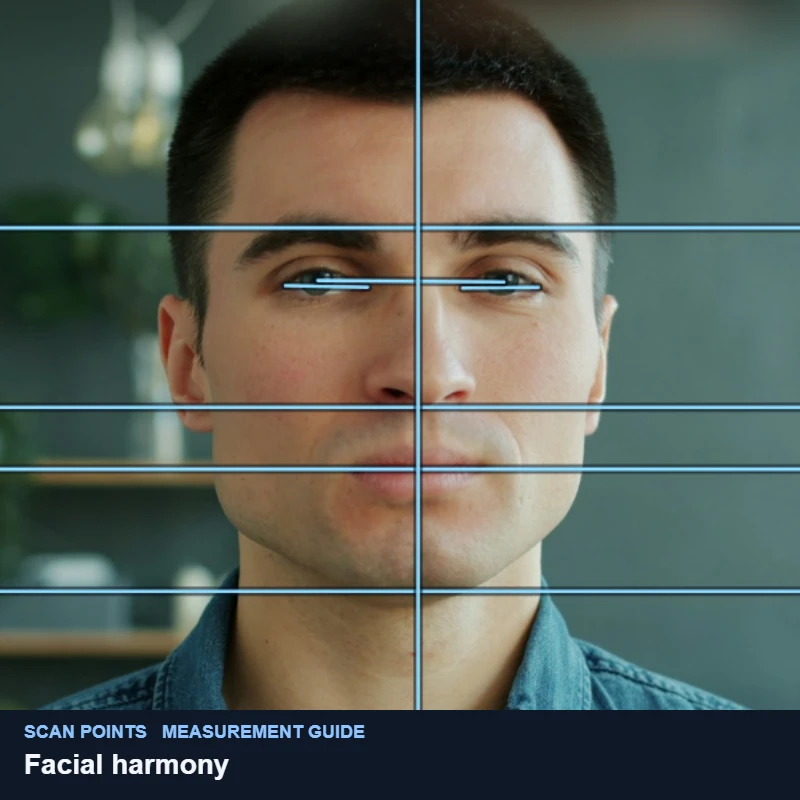
Example result
The proportions the facial harmony test combines, on a demo portrait. Scan guides are enlarged here so you can see what the tool reads.
Facial harmony test
- Even light
- Neutral expression
- Phone at eye level
- Clean background
- Even lightFace a window. No harsh shadows from above.
- Neutral expressionNo smile, no makeup. Hair off your forehead.
- Phone at eye levelShoulders to top of head. Chin neither up nor down — angle can fake a sharper jaw.
- Clean backgroundPlain wall or neutral space.
Embed this test on your siteFree, no sign-up
Paste this where you want the facial harmony test to appear: a blog post, a forum signature page, a barber's or clinic's site. It runs in your visitor's browser and never uploads their photo, so there is nothing to add to your privacy policy for it.
What is facial harmony?
In looksmaxxing forums and in aesthetic medicine, facial harmony means how well the parts of a face fit together: whether the proportions sit close to the balanced case and whether the two halves match. It is the idea behind rules like the thirds and fifths, and behind the claim that a face with ordinary features can be striking when they fit. The research version of the idea is averageness and symmetry, the two structural principles the reviews of facial attractiveness support best.
Harmony is not beauty. A harmony score cannot see skin, hair, eye colour, expression, grooming or body fat, all of which move real ratings. It also cannot see features that are well proportioned but unusual. Read the score as one ingredient, the structural one.
What does the harmony test score?
A face mesh runs on your photo on your device. The tool reads five things and scores each from 0 to 100, where 100 is the balanced value and the score falls as the proportion moves away from it. The overall score is their average.
| Part | What it compares | Balanced when |
|---|---|---|
| Symmetry | Mirrored landmark pairs across the midline | The halves match closely |
| Middle to lower third | Brow-to-nose against nose-to-chin | The two are about equal |
| Upper lip to chin | How the lips split the lower third | The upper lip takes about a third |
| Eye spacing | Inner-corner gap against eye width | About 1.2 eye widths as this mesh places the corners |
| Midface | Pupil distance against the eye-to-lip height | The two are about equal |
The balanced values are not textbook fractions. They are the typical values of real frontal photos run through the same mesh, because a mesh places landmarks a little differently from a ruler. The upper third is left out on purpose: the mesh cannot find the hairline, so any tool that scores the upper third from a mesh is scoring a guess.
How to read your harmony score
Most faces land between the sixties and the high eighties. A score in that range means proportions close to ordinary with one or two parts leaning, which in person nobody notices. The part the tool names as furthest from balanced is the useful output: it tells you which proportion leans, and whether it is one that framing can soften. A low symmetry part on one photo often means uneven light or a close lens, so run a second photo before reading much into it; a slight head turn is corrected before measuring.
Every part here is structural. The thirds, the lip split, the eye spacing and the midface are set by the skull, the maxilla, the mandible and the orbits, and nothing non-surgical changes them; BecomeTen does not recommend surgery. What changes how they read is framing: a beard for the lower third, brows for the spacing and the middle third, hair for the upper face, and body fat for the jaw line that closes the lower third.
A free facial harmony app for any phone
You do not need to install anything. This test runs in the browser, so it works the same on Android, on an iPhone and on a laptop, with no download, no account and no subscription. The face mesh and every calculation run on your device, and the photo is never uploaded. Some facial harmony apps are iPhone-only and charge a weekly subscription before they show a result; this one shows the score, the five parts and the part furthest from balanced for free, straight away.
What you give up by not installing an app is nothing that matters for the measurement. The same landmarks are read the same way. If you want the whole face read, skin, hair and eyes included, with a plan behind it, the full rating is also in the browser.
How to take the photo for a harmony score
- Straight on, camera at eye level. A small turn is corrected for the symmetry part; a larger one is flagged as low confidence; a tilt changes the thirds.
- Arm's length or further. A close lens enlarges the centre of the face and throws the midface and spacing.
- Neutral face, mouth closed. A smile moves the lips and the cheeks at once.
- No glasses, even front light. Frames hide the eye corners; side light makes the halves look different.
Questions
Is there a free facial harmony app for Android?
Yes: this page. It runs in any mobile browser on Android, as well as on an iPhone or a computer, without installing anything. The face mesh runs on your phone, the photo is not uploaded, and the harmony score and its five parts are free with no account or subscription.
Is a facial harmony score the same as an attractiveness rating?
No. Harmony covers proportion and symmetry only, the structural part. Attractiveness ratings also move with skin, hair, body fat, grooming and expression, which no landmark tool can see. A face can score high on harmony and rate average, or the reverse. The full rating reads all of these together.
Why is my facial harmony score different on another site?
Sites choose different proportions, different ideal values and different landmarks. Many score the golden ratio or the upper third from a mesh, which this test leaves out as unsupported or unmeasurable. Compare scores only within one tool, on photos taken the same way.
Can I improve my facial harmony?
Not the proportions themselves; they are bone. You can change how they read: brows and glasses for the eye area, a beard for the lower third, hair for the upper face, and a leaner face for a sharper jaw line. The full report tags each of these with its evidence level for your face.
Sources
- 1.Human (Homo sapiens) facial attractiveness and sexual selection: the role of symmetry and averageness — Journal of Comparative Psychology (1994)(Opens in a new window)
- 2.The evolutionary psychology of facial beauty — Annual Review of Psychology (2006)(Opens in a new window)
- 3.Facial attractiveness: evolutionary based research — Philosophical Transactions of the Royal Society B (2011)(Opens in a new window)