Journal · Jaw · evidence
How to get a better jawline without surgery: the levers, ranked
Body fat is the only lever with evidence that changes how a jawline reads, and it is a large one. Posture, a beard, a haircut and camera angle change how the jaw is seen without changing it. Mewing, jaw exercisers and gum have no evidence for bone.
A claim should come with its context.
Evidence levels describe support for a claim, not a guaranteed result.
Read the methodologyInside this article
Find the part you need.What is a jawline made of, in a photo?
Two layers. Underneath is the mandible, the lower jaw: its width at the angle, the gonial angle where the vertical branch meets the horizontal body, the length and forward projection of the chin. That layer is set by adult bone and does not move without surgery. On top is soft tissue: the fat under the chin and along the jaw border, the submental fat that fills in the angle between chin and neck, the masseter muscle, the skin over all of it, and any beard.
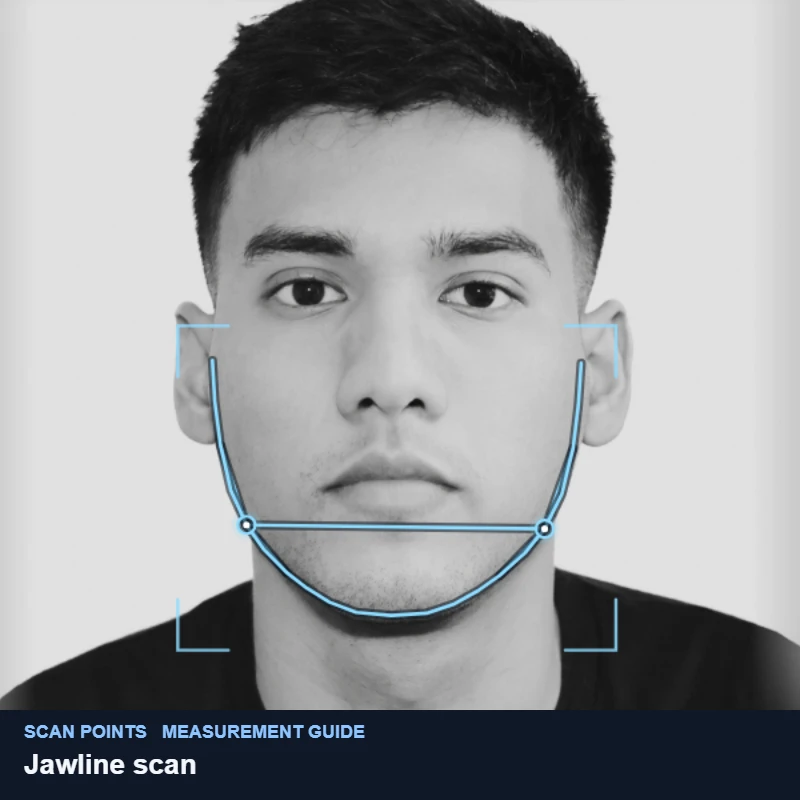
A camera sees the outline where the two layers meet the light. When people say they want a better jawline, they almost always mean a cleaner outline, and the outline is mostly the soft layer. That is the good news and the whole scope of what follows: everything on this page acts on the outline, and nothing on it acts on the bone.
Which levers actually move the jaw, ranked?
Ranked by how much of a change the evidence and plain optics support, largest first. Only the first row has research behind it; the rest are grooming and geometry, which are real but not studied.
| Lever | What it changes | Evidence | Timescale |
|---|---|---|---|
| Body fat | The soft layer over the whole lower third; submental fullness; how sharp the jaw border reads | Perception studies on facial adiposity and weight cues | Two to four months of a moderate deficit |
| Posture | Head forward and chin down bunches submental tissue; a neutral neck lengthens it. Changes the outline, not the tissue | None as a study; optics | Immediate in a photo; habitual with practice |
| Beard and grooming | A shaped beard draws a new outline over a soft one; a neckline set too high or too low moves the apparent chin | None as a study; framing | Weeks to grow, minutes to shape |
| Hairstyle | Volume on top and at the sides changes the ratio the lower third is judged against | None as a study; framing | One appointment |
| Photo angle | Lens at eye level and a step back render the jaw at its true width; a lens above and close narrows it | None as a study; optics | Immediate |
Why is body fat the largest lever?
Because the soft layer is where most of the outline lives, and body fat is the only thing that changes the soft layer substantially and for everyone. A lower body-fat percentage thins the pad under the chin and along the jaw border, so the mandible you already have shows through more. Nothing is being built; something is being uncovered. That distinction is why the change is capped: once the pad is thin, the bone underneath sets the limit, and for some faces that limit is a soft jaw even at low body fat.
The how, the timescale and why the face lags the bathroom scale are covered in why body fat is the biggest lever on your jawline and in body fat percentage and facial definition. The short form: a moderate deficit, held for months, judged on matched photos at 6–8 week checkpoints. Not a crash, which also costs muscle and can hollow the under-eye.
What do posture, grooming and hair actually change?
Posture is the honest version of the mewing claim. A head carried forward, with the chin dropped toward the chest, folds the submental tissue and erases the angle between chin and neck; a neutral neck, ears over shoulders, chin level, unfolds it. This changes what a camera sees today and it changes nothing under the skin. It is also the reason BecomeTen tells you to hold the same posture for every scan: it is worth points in a photo and zero as a treatment.
A beard draws a border where there is not much of one. Kept full along the jaw and trimmed to a clean neckline a little above the Adam's apple, it gives the lower face an edge that fat or a recessed chin has softened. Set the neckline too high and it shortens the chin; too low and it reads as a neck. Hair does a similar job from above. Volume at the sides widens the upper face and makes the jaw read narrower by comparison; height on top with tight sides does the reverse. None of it is bone, all of it counts in a photo, and all of it is tagged workable in the report because the score describes the photo.
What has no evidence: mewing, jaw exercisers and chewing gum
Mewing claims that tongue posture remodels the maxilla and the jaw in adults. There is no trial, no cohort study and no imaging series showing it, and adult facial bone does not respond to tongue pressure the way the claim needs. What mewing does not do goes through the argument; the summary is that any change in a mewing before-and-after is posture, body fat, lighting or time.
Jaw exercisers and hard chewing gum train the masseter, which is a muscle. A bigger masseter can widen the lower face at the angle a little, and it can also enlarge unevenly, ache and load the joint. It does not change the gonial angle, the ramus or the chin, because those are bone and muscle does not reshape them. BecomeTen labels these steps as having no studies in its library, which is not the same as weak evidence: there is nothing to grade.
Questions
Does a beard count as a jawline improvement in the score?
Yes, because the score describes the photo and a well-shaped beard changes the outline the photo shows. The facial hair trait is tagged workable, and a beard can lift jaw definition as the model reads it. It does not change the bone underneath, but a beard can hide the jaw corner and chin outline, so for the structural bands scan clean-shaven once.
How long does a leaner jawline take to show in a scan?
First signs can show at 6–8 weeks of a moderate deficit, with a clearer move outside the two-point noise band on matched photos at three to four months. The face often lags the scale by weeks, so a first 6–8 week checkpoint may show little. Judge at the second checkpoint, and keep camera height and posture identical or the angle will move the jaw score before the fat does.
Can neck exercises reduce a double chin?
There is no study in our library showing that neck or chin exercises reduce submental fat, and fat is not lost locally by working the muscle under it. What such exercises can do is make you more aware of head posture, which changes how the area folds in a photo. The fat itself responds to overall body composition, and the bone under it does not respond to anything non-surgical.
Is a weak chin the same problem as a soft jawline?
No. A soft jawline is usually soft tissue: submental fat and a border blurred by the pad over it, which body fat and grooming change. A weak chin is usually chin projection, which is bone and tagged structural. The two are often confused because both soften the lower third. The report separates them so that a plan does not promise a fat-loss fix for a bone trait.