Journal · Measurement · capture
Why is my face rating different every time?
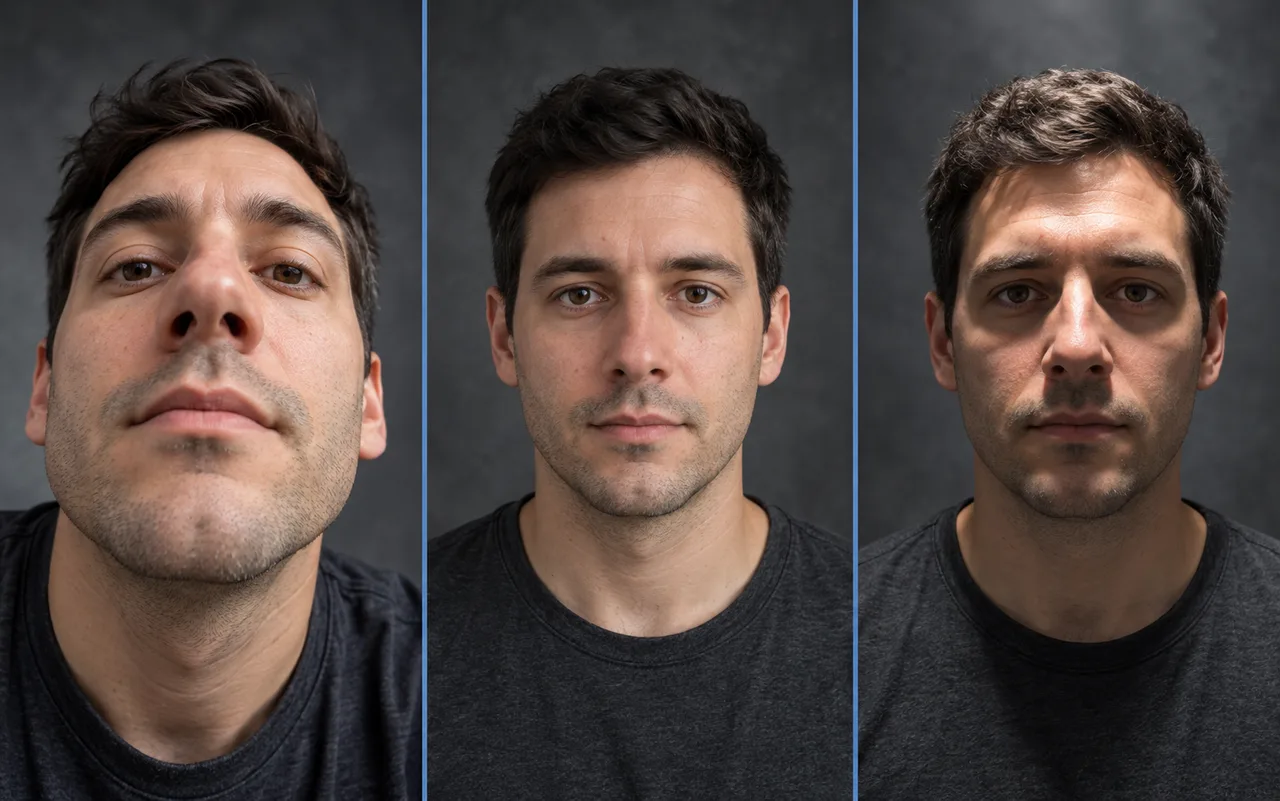
A face rating changes between photos because the photo changes, not the face. Light direction moves the skin and eye-area scores, camera height moves the lower third, a close lens enlarges the nose and shrinks the jaw, and expression and blur move everything. Hold those constant and the score holds within about two points.
Inside this article
Find the part you need.Why does the score change between photos?
Because the rater sees a picture, not a person. It has one two-dimensional image and infers everything — depth, projection, skin texture, the line of the jaw — from how light lands on that image. Change the light, the angle or the distance and you have changed the evidence, and a different estimate is the correct response to different evidence. The variance is not a bug in the rater; it is a property of photographs.
The fix is not to find the flattering setup. It is to find one setup and keep it, so that the only thing changing between scans is you. Best lighting for a face rating means the most repeatable lighting, which is also, usefully, the most honest. The full checklist is in how to track progress; this article explains what each variable does and why.
Light direction: what it does to skin and the eye area
Light from directly overhead — most ceiling fixtures — drops the brow ridge into shadow over the eyes, deepens the under-eye hollows, darkens the sides of the nose and puts a line under the lower lip. On a scan that reads as darker circles, a heavier upper lid and a less even tone, all of which pull the eye-area and skin scores down. The face has not changed; the shadow map has.
Hard light from one side does the opposite trick on the lower third: it throws the jaw border into a clean shadow edge and makes it read as sharper than it is, while the lit side of the face shows every pore and the shadow side hides them. Flat, even, front-on daylight from a window — not direct sun — shows the skin and the shape as they are, and it is the easiest condition to reproduce in two months. Ring lights are acceptable if they are the same ring light at the same distance every time.
Camera height and angle: the lower third moves first
Angle is the single most common false positive on a re-scan. A phone held above eye level, tilted down at the face, makes the forehead and eyes larger, the chin smaller and the jaw narrower — a softer lower third. A phone held below eye level, looking up, does the reverse: bigger jaw, more visible nostrils, shorter-looking midface.
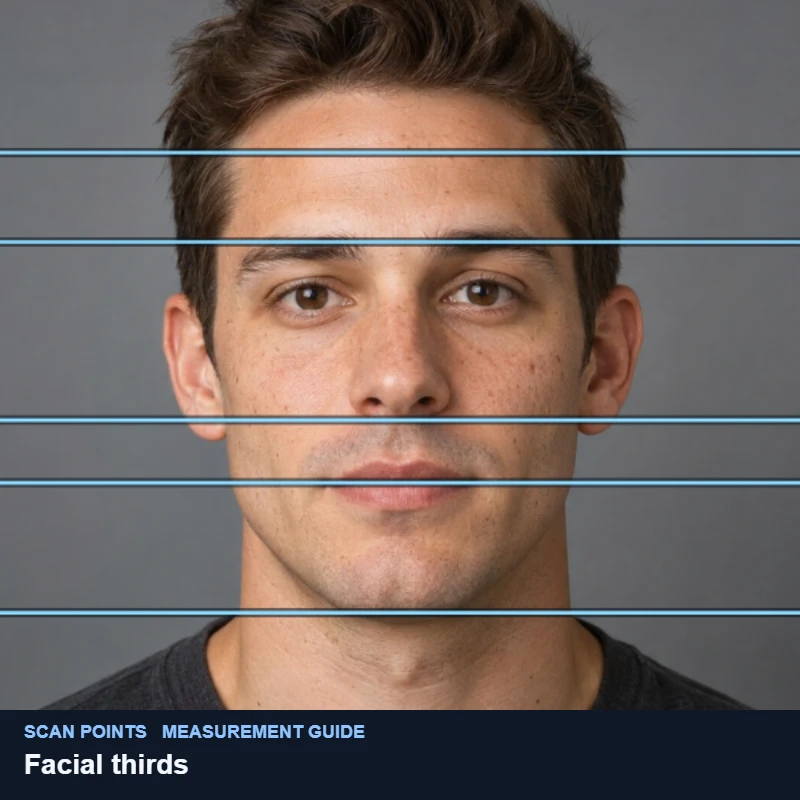
Head tilt is the other half. A chin tucked slightly down makes the jaw and chin read smaller and softer and can shorten the apparent lower third of the facial thirds; a chin lifted a little lengthens it, shows the jaw underside and makes the jaw read heavier. Either is a few degrees away from neutral and either can move the jaw-and-chin area score by more than the two-point noise band. This is why BecomeTen grades angle as frontal, slightly off or off, and why a re-scan shows your original photo as a faint alignment layer on the camera screen.
Take it by a window at eye level — the score and tier are free and the photo is deleted after scoring.
Lens distance and focal length: the close-up penalty
A phone's front camera is wide-angle, and any wide lens held close to a face exaggerates whatever is nearest and shrinks whatever is farthest. Nearer than arm's length, that means a larger nose, a wider midface, smaller ears and a narrower jaw and chin. The facial fifths — the horizontal proportions the harmony area uses — are distorted directly, and a slightly wide-set or close-set eye reading can appear or disappear with distance alone.
The remedy is distance. Step back until the whole head and the top of the shoulders fit comfortably in frame, then, if the phone allows, use a mild zoom or the rear camera rather than moving closer. A longer effective focal length flattens the perspective and gives a rendering closer to how a person sees you from across a table. Same distance every time matters more than the exact distance.
Expression and sharpness
A smile lifts the cheeks, narrows the eyes, widens the lower face and changes the apparent canthal tilt; clenched teeth widen the jaw at the angle; raised brows change the brow position and the visible upper-lid exposure. Any of these is a legitimate look and none of them is comparable to a neutral face in another photo. Neutral means relaxed mouth, teeth apart, brows at rest, eyes open normally.
Sharpness is quieter but it moves the skin area most. A soft or blurry photo hides texture, pores and unevenness, so skin reads better than it is; a very sharp photo in hard light does the opposite. Beauty filters and the default smoothing on some front cameras count as blur. Turn them off, focus on the eyes, and hold still or prop the phone.
Which mistake moves which area
| Variable | Typical mistake | Area moved most | Direction |
|---|---|---|---|
| Light direction | Overhead ceiling light | Eye area, skin | Down: darker circles, uneven tone |
| Light direction | Hard light from one side | Jaw and chin, skin | Jaw up, skin mixed |
| Camera height | Phone above the eyes, tilted down | Jaw and chin | Down: narrower jaw, smaller chin |
| Head tilt | Chin tucked | Jaw and chin, harmony | Down: softer jaw, lower third shorter |
| Lens distance | Front camera closer than arm's length | Harmony | Wider midface, narrower jaw |
| Expression | Smile or clench | Eye area, jaw and chin | Mixed; not comparable |
| Sharpness | Blur or a smoothing filter | Skin | Up: texture hidden |
What BecomeTen does with a bad photo
Every photo is graded before scoring on lighting (good, uneven, poor), angle (frontal, slightly off, off) and sharpness (good, soft, blurry). A photo that fails is still rated — you get the score and tier — but the report tells you it is lower quality and that tracking from it will be less precise, and suggests a new shot. A refusal would be worse than a flagged number.
On a re-scan the grade decides whether a comparison is shown at all. If either the baseline or the new photo fails, the change from baseline is withheld and the report says so, with the fix: face a window, front-on, in focus. Where both pass but differ in light or angle, the comparison is shown with a low-confidence note. And a change within two points is always shown as noise, because two photos of the same face can differ by that much from lighting and angle alone.
Questions
Is a mirror selfie better than the front camera?
Usually yes, if the mirror is clean and the light is even, because you use the rear camera from further away and the perspective flattens. The downside is that you cannot see the alignment layer on a re-scan. A propped phone with the front camera at eye level and a step back is the most repeatable option.
Does the time of day matter?
Daylight through a window changes colour and intensity across the day, and the face itself is fuller in the early morning. Pick a time you can repeat — mid-morning is a common choice — and keep it. The absolute time matters less than using the same one for every scan in a series.
Should I take the photo with or without glasses?
Without. Frames hide the brow position, the eye spacing and part of the under-eye, and lenses shift the apparent size and position of the eyes. If you wear glasses every day and want the rating to reflect how you look to others, that is a fair choice, but make it once and keep it for every scan.
Can I upload a professional or edited photo?
You can, and the rating will describe that photo. Retouching hides skin texture and sometimes reshapes the jaw, so the score will be higher than a plain photo would give and it will not be a usable baseline for tracking. For a number you can act on, upload an unedited photo taken the way you can take it again.
Sources
- 1.Color homogeneity and visual perception of age, health, and attractiveness of female facial skin — Journal of the American Academy of Dermatology (2007)(Opens in a new window)
- 2.Cues of fatigue: effects of sleep deprivation on facial appearance — Sleep (2013)(Opens in a new window)
- 3.Facial adiposity: A cue to health? — Perception (2009)(Opens in a new window)