Tool · Eye area
Canthal tilt test
This canthal tilt test runs in your browser and tells you whether the line from the inner to the outer corner of each eye slopes upward, sits level or slopes downward: positive, slightly positive, neutral or negative. It shows a band per eye beside the measured slope, with a reminder that camera height and a head turn move the apparent slope more than anatomy varies.
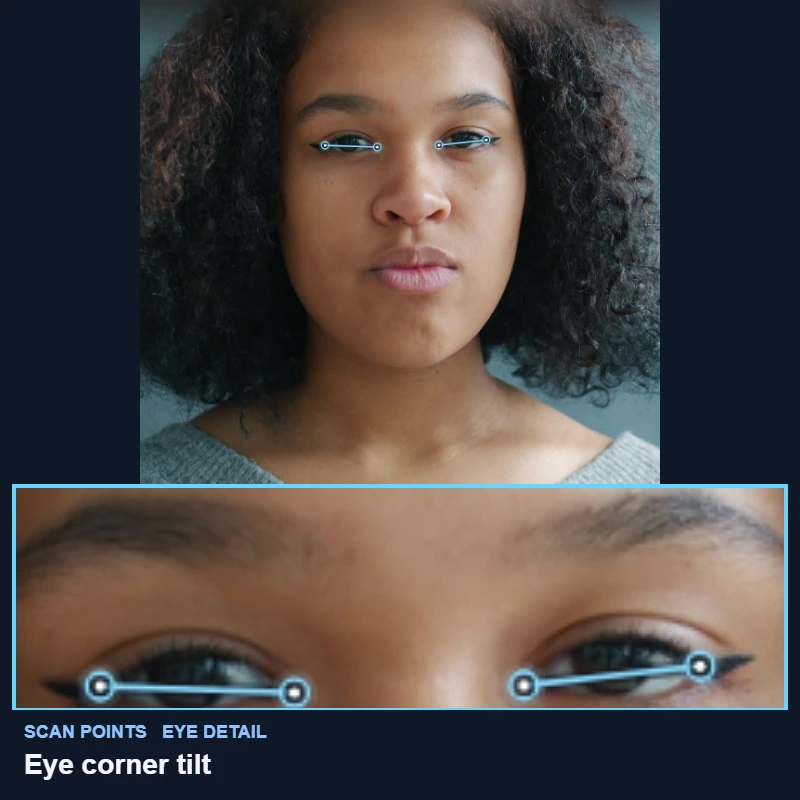
Example result
The eye corners the canthal tilt test measures between, on a demo portrait. Scan guides are enlarged here so you can see what the tool reads.
Canthal tilt test
- Even light
- Neutral expression
- Phone at eye level
- Clean background
- Even lightFace a window. No harsh shadows from above.
- Neutral expressionNo smile, no makeup. Hair off your forehead.
- Phone at eye levelShoulders to top of head. Chin neither up nor down — angle can fake a sharper jaw.
- Clean backgroundPlain wall or neutral space.
Embed this test on your siteFree, no sign-up
Paste this where you want the canthal tilt test to appear: a blog post, a forum signature page, a barber's or clinic's site. It runs in your visitor's browser and never uploads their photo, so there is nothing to add to your privacy policy for it.
What does the canthal tilt test measure?
Canthal tilt is the slope of the line between the inner corner of the eye, the medial canthus, and the outer corner, the lateral canthus. The tool runs a face mesh on your photo, finds those two points on each eye, and compares the height of the outer corner with the inner one. Outer corner higher: positive, and the eye reads upturned. Level: neutral. Outer corner lower: negative, and the eye reads downturned. Both eyes are reported separately, because they are rarely identical, and the whole calculation happens on your device with nothing sent anywhere. The output is a band, and that is deliberate. The full definition, and why forums care about it, is under canthal tilt in the glossary; the short version is that the outer corner is anchored by a ligament to the rim of the orbit, and the skull decides where that rim sits.
How to take the photo for a tilt reading
The tilt is a small slope, and the camera adds its own. The rules below matter more for this tool than for almost any other on the site.
- Head straight, no turn. The tool levels a head tipped toward one shoulder before it measures, but a head turned to the side shifts the corners, and the result is marked low confidence.
- Camera exactly at eye level. A camera above the eyes with the chin dropped makes both eyes read more upturned; a camera below does the opposite. Neither is your tilt.
- Arm's length or further. A close lens bends the outer face and shifts where the outer corners appear.
- Eyes open normally, looking at the lens. Squinting pulls the outer corners; looking up or down moves the lids over the corners.
- Brows relaxed. A frown drops the brow tail over the outer corner and hides where the corner actually is.
How to read a canthal tilt result
You will see a band for each eye: positive, slightly positive, neutral or negative. Slightly positive is the ordinary case: most adults' outer corners sit a little higher than the inner ones. Neutral reads level and balanced; clearly positive reads alert. Clearly negative is less common, and if the tool reports it on a square-on, eye-level photo, retake once with the camera at eye height and the chin level before you believe it. If the two eyes land in different bands, that is usually a small turn of the head or a genuine slight asymmetry, and the second photo will tell you which. Do not read the degree figure as a measurement of your anatomy. It is how far from level the line appeared in this photo, which is partly your anatomy and partly the camera, and the tool cannot separate the two.
Negative canthal tilt: is it bad?
A negative canthal tilt means the outer corner of the eye sits lower than the inner corner, so the line between them slopes down. It is a normal variation, not a defect, and on its own it is not a health issue. It is also less common than the internet suggests: most adults have a slightly positive tilt, and most photos that look negative were taken from a little below eye level or with the chin raised, which turns the outer corners down in the image. Check that first, with the camera exactly at eye height.
The forums treat a negative tilt as a flaw, and there is a grain of evidence behind the worry: eyes that turn down at the outer corner can read as tired. In real ratings, though, tilt is a small factor next to skin, sleep and the under-eye area, and faces with a downturned eye are rated highly all the time. The tilt is bone and ligament and does not change with exercises or mewing. The downturned eyes test answers the question directly, and the upturned eyes test covers the opposite case.
The red-line filter that went viral on TikTok draws the same line from inner to outer corner. The difference here is that the tool levels the head before it measures, so a tilted phone or a tilted head does not count as a tilted eye.
What the test cannot tell you
It cannot give you your anatomical angle. The tool shows the measured slope in degrees for comparing your own photos, but read the band, not the decimal. A photograph flattens the orbit onto a plane, and the apparent slope changes with a head turn, camera height, lens distance and even which way you are looking. The differences those introduce are larger than the differences between most people's real tilts. The band is the honest resolution of a photo, and the full rating, under the methodology, reports tilt as a band rather than in degrees. It also cannot tell you whether your tilt is a problem. Forums frame anything short of clearly positive as a loss. The perception research does not. The 2011 review of facial attractiveness supports averageness, symmetry and sex-typical features; there is no upturned-eye rule in it, and a neutral tilt on a rested, well-framed eye reads well.
Is canthal tilt structural or workable?
Structural. The outer corner is held by the lateral canthal ligament, which attaches to bone, and nothing non-surgical relocates it. Eye exercises, pulling at the corner, tape and squinting drills stretch thin eyelid skin and nothing else. BecomeTen tags the tilt structural, the plan never promises to change it, and the potential image is forbidden from redrawing it. Canthoplasty exists; BecomeTen does not recommend surgery at any tier. What is workable is what surrounds the corner. A brow tail that drops low over the outer corner makes a neutral eye read downturned, and tidying it is the cheapest lever on this page. Puffiness at the lower outer corner fills in the line; a study photographing the same people rested and sleep-deprived found the tired faces were judged to have more hanging eyelids and swollen eyes. And the photo itself: chin down and camera high fakes a positive tilt, which is why the full rating grades the capture rather than rewarding it.
Questions
Why should I read the band rather than the degree figure?
Because a photo cannot pin down your real angle. The apparent slope shifts with a head turn, camera height and lens distance by more than real tilts differ between people, so the decimal read off a selfie is partly camera. The band, positive, slightly positive, neutral or negative, is the resolution the photo can honestly carry, and the full BecomeTen report uses bands too.
My left and right eyes got different tilt bands. Is that normal?
Often, yes. Faces are asymmetric, and a slight difference in outer-corner height between the eyes is common. But a head turned slightly to one side can produce the same pattern, so retake the photo facing the lens squarely. If the bands still differ, it is your face; if they now match, it was the camera.
Does a positive canthal tilt make you more attractive?
Not by the evidence. The 2011 review of attractiveness research supports averageness, symmetry and sex-typical features, and none of it isolates an upturned eye as a driver. Forums treat positive tilt as central because it is part of the hunter-eyes ideal, which is a community preference rather than a finding. Neutral reads balanced and rates well.
Can the tilt test tell me whether I need canthoplasty?
No, and it should not. The tool reports what the photo shows, as a band, and BecomeTen does not recommend surgery at any tier. What it can do is show that a brow tail, under-eye puffiness or a tilted camera was making a neutral eye read negative, which is the part you can change without anyone touching a ligament.