Tool · Harmony
True mirror online: how others see you
This true mirror shows your front camera un-mirrored, so you see your face the way other people see it, not the reversed version a mirror shows. You can switch between the two, and with a photo you can flip it and see each half of your face doubled. It runs in your browser; the camera and photo never leave your device.
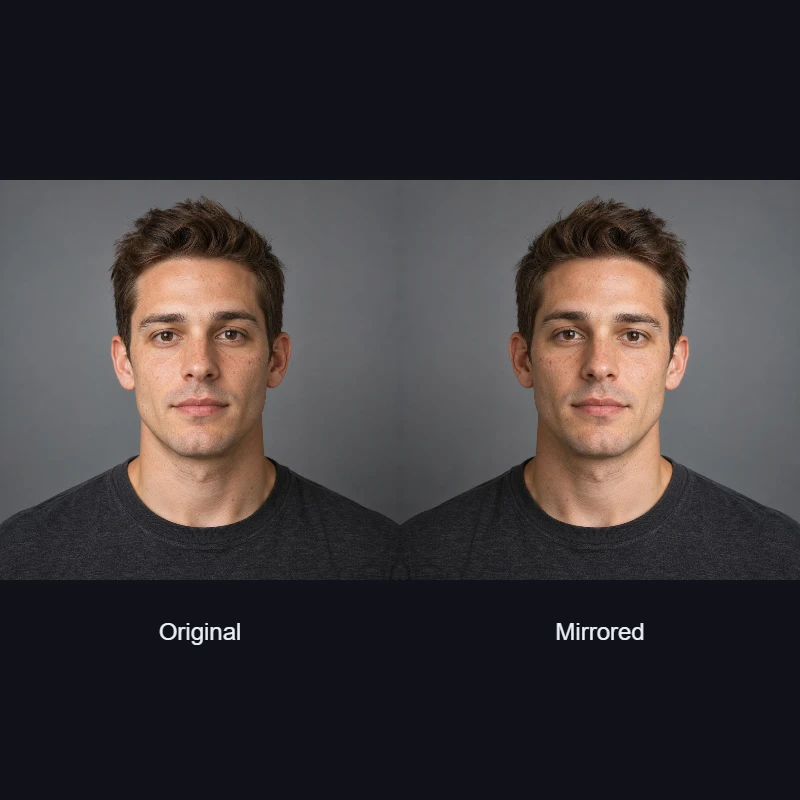
Example result
The same demo photo shown normally and mirrored. The tool also offers a live camera view and doubled face halves.
See yourself the way others do
- Even light
- Neutral expression
- Phone at eye level
- Clean background
- Even lightFace a window. No harsh shadows from above.
- Neutral expressionNo smile, no makeup. Hair off your forehead.
- Phone at eye levelShoulders to top of head. Chin neither up nor down — angle can fake a sharper jaw.
- Clean backgroundPlain wall or neutral space.
What is a true mirror?
An ordinary mirror reverses left and right. The face you have seen every day of your life is that reversed face, and it is not the one anyone else sees. A true mirror, also called a non-reversing mirror, shows the face the right way round. Physical true mirrors use two mirrors at a right angle; online, the same thing is done by showing the camera without the mirror flip that phones add to the selfie preview.
The difference is only visible because no face is perfectly symmetric. A parting that sits on one side, a slightly higher brow, a crooked smile or a nose that leans a little all swap sides between the mirror and the true view. The face symmetry test measures how large those differences are, feature by feature.
Why do I look different in the true mirror?
Mostly familiarity. People tend to prefer what they have seen most often, and the face you have seen most often is your mirror image. Your friends have seen the other version, which is why a photo of you can look odd to you and normal to them. The unfamiliar version is not less attractive; it is just less familiar to you, and the strangeness fades after a few days of looking at it.
The TikTok inverted filter does the same flip on a video, and people are often surprised by it for the same reason. Neither view is the real one in any deeper sense: other people see the true view, and you are used to the mirror view.
How to use the true mirror
- Live: open the camera and you see the true view first. Switch to the mirror view and back to see which features move.
- Photo: pick a photo and the tool levels your head, then shows it flipped and split down the middle of your face, each half doubled.
- Phone selfies: many phones save front-camera photos un-mirrored even though the preview was mirrored, which is why a selfie can look different from the screen a second earlier.
- Light: face a window and keep the phone at eye level; side light exaggerates the difference between the two halves.
What the doubled halves show, and what they do not
Doubling each half of the face is an old way to make asymmetry visible: the left half mirrored makes one face, the right half mirrored makes another, and the two often look like relatives rather than the same person. That is normal. Every face has some asymmetry, and small differences are invisible in ordinary life. The research on facial attractiveness does find a preference for symmetry, but a modest one, and the doubled faces exaggerate the effect because the midline and the head angle are never perfect in a photo.
Can the difference between the two sides be changed?
The bony asymmetry is structural and does not change with exercises. What changes how asymmetric a face reads is often simpler: a parting moved to the other side, brows groomed to the same height, and photo angle. If one side has always looked better to you in the mirror, it is probably the other side in the true view, which is worth knowing before choosing a parting or a photo angle.
Questions
Is a true mirror how other people see me?
Yes, for the left-right orientation. Other people see your face the right way round, which is what a true mirror or an un-mirrored camera shows. It is not the whole story, because people also see you in motion, from different angles and in different light, but the orientation is the part a mirror gets wrong.
Why do I look better in the mirror than in photos?
Largely because you are used to your mirror image and people prefer what is familiar. Photos also add lens distortion, a fixed angle and flat light, none of which a mirror has. The true mirror removes the orientation difference, so what is left between it and a photo is the camera.
Does the true mirror record or upload my face?
No. The live view is the camera stream shown on your screen, not recorded. A photo you pick is processed in your browser to flip it and split the halves, and it is never uploaded. Closing the page discards everything.
Sources
- 1.Human (Homo sapiens) facial attractiveness and sexual selection: the role of symmetry and averageness — Journal of Comparative Psychology (1994)(Opens in a new window)
- 2.Facial attractiveness: evolutionary based research — Philosophical Transactions of the Royal Society B (2011)(Opens in a new window)