Journal · Composition · lower third
Why body fat is the biggest lever on your jawline
The jawline most people want is not a different bone; it is the bone they already have with less fat over it. Gonial angle and ramus length do not change without surgery, but the soft-tissue layer covering them does, and for most adults that layer is the single largest non-surgical change available.
The outline and balance of the lower face.
Explore jaw & chinInside this article
Find the part you need.You are uncovering, not rebuilding
Gonial angle and ramus length are bone and do not change without surgery. What does change is the layer of fat over them. Face-perception research repeatedly finds facial adiposity to be a strong, readable signal — which is why the same skull reads very differently at a different composition.
Moderate and long, not fast
Aggressive dieting costs muscle too, and on the face it reads as depletion rather than sharpness. A moderate deficit, enough protein and resistance training is the boring path that works. If your relationship with food is complicated, that is a conversation for a professional, not an app.
How much of a jawline is fat, and how much is bone?
Nobody can put a number on that from a photograph, and BecomeTen does not try. What the perception literature does show is the direction. A 2009 study in Perception found that facial adiposity — how heavy a face looks — is read by observers as a cue to health and attractiveness, and a 2010 follow-up in the same journal showed that observers pick up quantifiable visual cues to body weight from the face alone, including the face's width relative to its height and cheek width relative to jaw width.
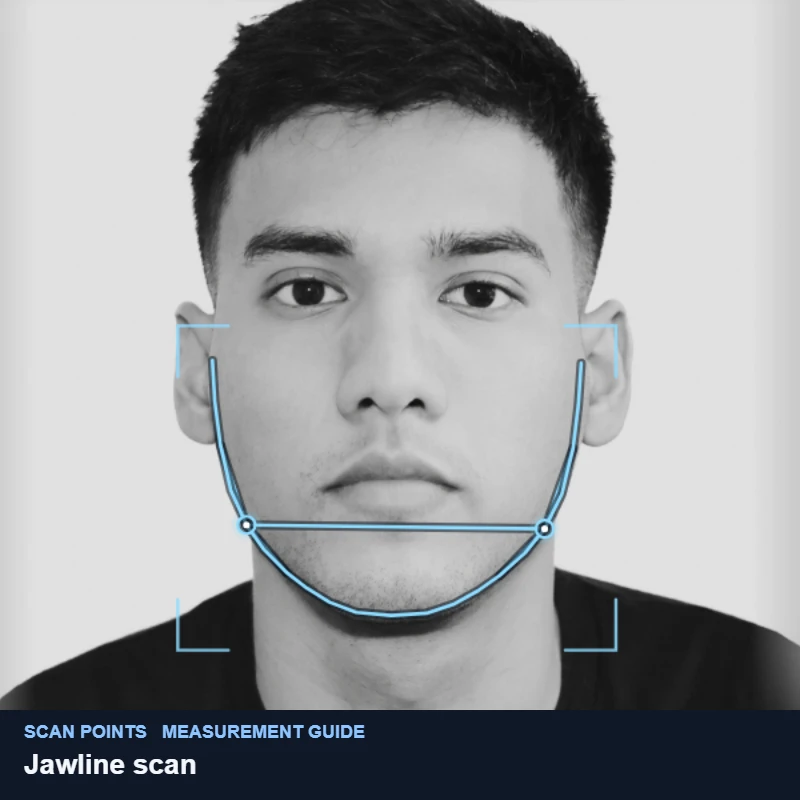
The practical translation: the mandible sets the ceiling, and the fat layer over it decides how much of that ceiling anyone sees. Two people with a similar bone can present a defined jaw and a soft one, and the difference is composition, not anatomy. The jaw and chin area is one of the five areas BecomeTen scores, and it carries the third-largest potential cap (+14), after skin and hair, precisely because soft tissue moves.
Score and tier free — then see where your jaw and chin sit and how much of it is workable.
What does a moderate deficit change, and over what timescale?
A moderate deficit changes three things the camera sees. First, submental fullness — the soft area under the chin that blurs the line between jaw and neck. Second, the fat pads over the lower cheek and along the jaw border, which soften the angle. Third, general facial puffiness that comes and goes with sodium, alcohol and sleep. The first two are slow and real; the third is fast and reversible.
Timescale matters more than intensity. Fat comes off the face at the body's overall pace, and a sustainable deficit moves body weight by a small fraction of a kilogram per week. That means the first signs under the chin typically show at six to eight weeks, clearer change at three to four months, and the fuller effect by around six months. Anyone promising a jawline in two weeks is describing water loss or a lighting change.
- Keep protein high so the loss is fat rather than muscle; a gaunt face is not the goal.
- Lift or do resistance work two or three times a week; it protects the tissue you want to keep.
- Expect the scale to move before the mirror does, and the mirror to move before a scan does.
Why does the face lag the scale?
Fat is not lost evenly. Where it comes off first and last is set by genetics and hormones, and for many people the face and neck are late in the order. So the number on the scale can fall for weeks while the lower third looks unchanged, then shift over a short period once the layer thins enough for the bone edge to read. This is normal and it is the main reason people give up a month in.
The other lag is perceptual. You see your face every day, so a slow change is invisible to you; a friend who has not seen you for six weeks notices at once. A scan under matched conditions sits somewhere between those two — it does not remember your face the way a friend does, but it also does not habituate.
Posture and lens distance move the jaw before fat does
Two things sharpen or soften a jaw in a photo with no change in the person at all. The first is head posture: a chin pushed slightly forward and level stretches the skin under the mandible; a chin tucked toward the chest folds it. The second is lens distance: a phone held close, nearer than arm's length, magnifies whatever is closest to the lens and shrinks the sides of the face, which can make a jaw look either wider or narrower depending on the tilt.
Neither of these is a trick you should use to improve the score. They are variables to hold constant so the score reflects you rather than the camera. Same window, phone at eye level, a step further back than feels natural, neutral expression. The full setup is in how to track progress.
What should a re-scan show at 6–8 weeks?
If the deficit has been real and the two photos are comparable, the honest expectation at six to eight weeks is a small movement in the jaw and chin area — most often in submental definition first, jawline definition second. A change within two points is measurement noise and BecomeTen shows it that way. A larger change in the right direction, with the photo graded as comparable, is a signal. Regressed and unchanged are both valid outcomes and the re-scan is allowed to say so.
What a re-scan will never report is a change in gonial angle or ramus length, because there is none. If a photo pair makes the bone look different, the difference is angle, distance or lighting, and the capture grade usually catches it. The longer view — what composition does to the whole face, not only the jaw — is in body fat percentage and facial definition.
What does not work
Creams, rollers and massage tools do nothing to fat under the chin beyond temporary swelling changes. Neck training has a real effect on the neck's appearance but not on the fat over the jaw. The one non-surgical lever with a consistent, visible, evidence-backed effect on how the lower third reads is composition. Everything else is either a photo variable or a myth.
Questions
Can you lose fat from the face specifically?
No. Fat loss is systemic; you cannot direct it to the face with exercises, creams or gadgets. The face thins when the body does, in an order set by your genetics. The only way to change where the fat comes off is not available to you — so the plan is body-wide: a moderate deficit, protein, resistance work, patience.
Will losing weight make my jaw look narrower or wider?
Usually more defined rather than narrower. As the fat over the jaw border and under the chin thins, the edge of the mandible becomes visible and the angle reads sharper. The bone itself has not changed, so the width of the jaw stays; what changes is how much of its outline the camera can see.
How much weight do I need to lose before a scan notices?
There is no single number, because faces store fat differently. A useful rule is that the scan lags the scale: expect the first signs in submental definition at six to eight weeks of a sustainable deficit and a clearer change at three to four months, judged under matched light and angle. A change within two points is noise.
Does a jaw exerciser help at all?
It grows the masseter muscle, which can make the lower face wider and rounder. It does not reduce fat, does not change bone and does not sharpen the angle. If your goal is a defined jawline rather than a wider one, it works against you. BecomeTen's plan never recommends one.