Journal · Myths · reality
What mewing does not do in adults
Mewing does not change adult facial bone. There are no clinical trials showing that tongue posture moves the maxilla, the mandible or the gonial angle once growth has finished. What it can do is change head and neck posture, which changes how a jaw reads in a photo. BecomeTen's plan labels mewing as having no studies.
A claim should come with its context.
Evidence levels describe support for a claim, not a guaranteed result.
Read the methodologyInside this article
Find the part you need.There are no studies, not weak ones
There are no clinical trials showing that tongue posture changes adult facial bone geometry. What you will find instead is before-and-after photos and testimony, and neither is evidence. This is why BecomeTen's plan always marks mewing as having no studies rather than stretching an unrelated paper to cover it. A rater that cites a real source for sunscreen and a fake one for tongue posture would be worthless on both.
What helps, and what is dangerous
Head and neck posture changes how the jaw line reads, both in photos and in person, and that is legitimate. What does not work — and what is dangerous — is bone smashing, striking the mandible or the cheekbones, and any related forum advice. Damaging tissue is not remodelling it. BecomeTen refuses to recommend it, and the refusal is written into the prompt, not left to the model's judgement.
What does mewing claim?
The claim, in its common form, is that resting the whole tongue against the roof of the mouth, keeping the lips closed and breathing through the nose will, over months or years, push the maxilla forward and upward, widen the palate, lift the cheekbones and sharpen the jaw. Stronger versions add that it can correct a recessed chin or reshape the eye area by moving the orbital bones.
Some of this is borrowed from a real field. Orthodontists and myofunctional therapists do work with tongue posture and oral habits in children, whose facial bones are still growing and whose sutures have not fused. The looksmaxxing version takes a paediatric idea and applies it to adults, where the sutures of the midface have closed and the mandible has finished growing. That extension is the part with no support.
See which of your traits are workable and which are structural — free score and tier, no sign-up.
What would count as evidence, and why is there none?
Evidence for a bone claim would look like this: a group of adults assigned to the practice and a comparable group not assigned, imaging of the skull before and after a defined period, measurements taken by people who do not know which group each person was in, and a difference larger than the measurement error. That is a modest bar. Orthodontics clears it routinely for appliances that apply continuous, measurable force.
Nothing like it exists for mewing. The reason is not a conspiracy; it is biology. Adult bone remodels in response to sustained mechanical load, and the tongue at rest does not apply anything close to the force an orthodontic appliance does, nor in a direction that would move a fused maxilla. Anyone who ran the trial would expect a null result, which is why nobody funds it and why the claim survives only in forums.
- No randomized trial in adults.
- No before-and-after imaging study in adults with blinded measurement.
- No mechanism that explains adult bone movement from resting tongue pressure.
Why are before-and-after photos not evidence?
Because almost everything that makes a jaw look different in a photograph is not bone. Camera angle first: a chin tilted a few degrees down makes the jaw and chin read smaller and shortens the lower third, and a chin tilted up shows the jaw underside and makes it read heavier. Lighting second: side light throws the jaw border into shadow and makes it read as an edge; flat light erases it. Body composition third: two years between photos is enough for a young man to lose facial fat with no change in habit, and enough for anyone to lose or gain several kilograms.
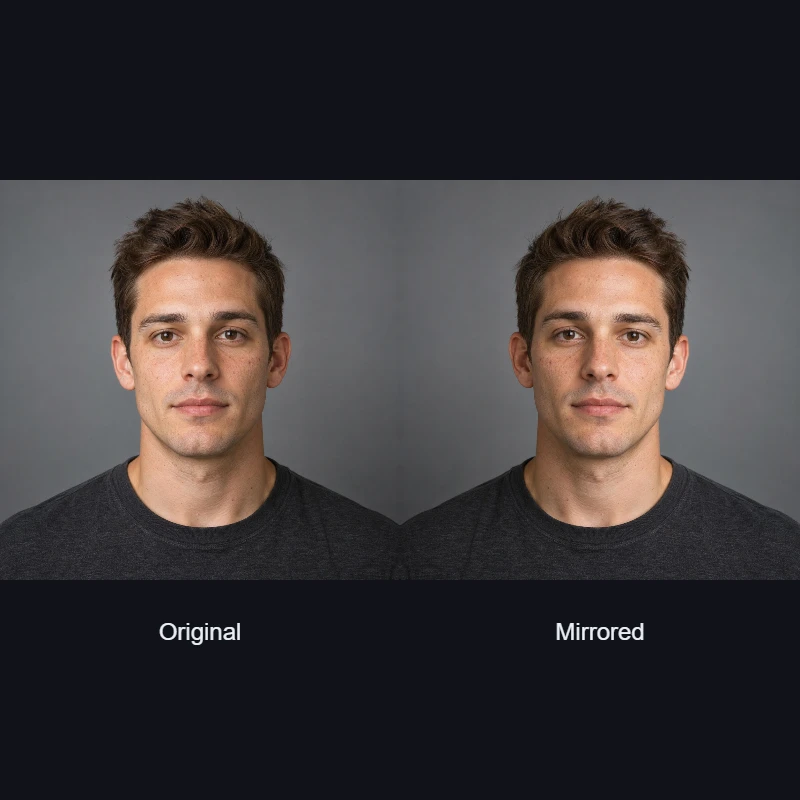
Add facial hair, a haircut that changes the visible width of the face, a better phone, and the fact that people post the pairs that look impressive and not the ones that do not. A before-and-after can be entirely honest and still show nothing about bone. This is the exact reason BecomeTen grades every photo for lighting, angle and sharpness and withholds a comparison when the two are not comparable.
| Credited to mewing | Likelier cause | How to check |
|---|---|---|
| A sharper jaw | Lower body fat. The fat layer over the mandible decides whether the bone shows; a young adult often loses facial fat over two years with no change in habit | Compare bodyweight and the area under the chin between the two photos; read body fat and the jawline |
| Better photos | Posture and camera height. A chin held level and a lens at eye level, further away, sharpen the jaw and shrink the nose on any face | Re-take the earlier photo at the same distance and height; run both through the jawline score tool |
| A feeling of change | Head and neck posture. A closed mouth and a neutral head position unfold the soft tissue under the chin, and the change is felt at once | Notice that the feeling arrives in days and bone claims take years; the speed gives the mechanism away |
The body-fat row deserves the most weight because it has the most evidence behind it. A 2009 study in Perception found that facial adiposity, the amount of fat visible in a face, is a cue observers use when they judge health and attractiveness, and a 2010 study in the same journal showed that weight can be read reliably from a face image, from cues such as the width of the cheeks against the width of the jaw. Those are exactly the cues a mewing before-and-after appears to change. Nobody needs tongue posture to explain them; a modest change in body composition does it, and it does it on the same timescale as the photos. The jawline score tool reads the jaw corner and jaw width from one photo in the browser. Re-run it on matched photos after a change in body fat to see whether the corner sharpens, which is the honest version of the comparison people are trying to make.
The posture point, done honestly
Here is what is true. A forward head position folds the soft tissue under the chin and hides the jaw border; a neutral head position with the chin level unfolds it. People who start mewing usually also start paying attention to posture, closing the mouth and breathing through the nose, and those habits do change how the lower third reads in a photo and in a room. The effect is real and immediate and it has nothing to do with bone.
It is also fair to say that nasal breathing and a closed resting mouth are ordinary good habits with benefits beyond appearance. If mewing is the reason someone adopts them, fine. The error is attributing a posture change to skeletal change, then spending years waiting for a maxilla that is never going to move. Keep the habit; drop the expectation.
What BecomeTen's plan says about mewing
Every step in a BecomeTen plan carries one of four evidence levels: strong, moderate, weak or no studies. The AI model is not allowed to cite from memory; it may only attach sources from a curated library, and the server rejects any id that is not in it. There is no entry for mewing in the library, so if the plan mentions tongue posture at all it appears with the no-studies label and no citation.
In practice, the plan handles the jaw and chin area the way the evidence does. The workable traits are jawline definition, submental definition and maxilla support as it reads through soft tissue; the levers are body composition, posture and grooming. Gonial angle, ramus ratio and chin projection are tagged structural and the plan may not promise a fix for them. That split is the product's whole position on mewing, stated in the report rather than argued in a forum.
Questions
Does mewing work if you are under 18?
BecomeTen is for adults and does not advise on children. In people who are still growing, tongue posture and oral habits are a real topic in orthodontics and myofunctional therapy, and that is a conversation for a specialist, not a forum. None of that transfers to an adult skull whose growth has finished.
Can mewing change the shape of my palate or my breathing?
There is no adult evidence for palate expansion from tongue posture. Nasal breathing and a closed resting mouth are ordinary habits worth keeping, and some people find them easier once they pay attention to tongue position. That is a habit benefit, not a skeletal one, and it does not change a rating.
Why does my jaw look better after months of mewing, then?
The usual explanations, in order: you hold your head differently now, you lost some facial fat, your photos are taken from a different angle or in different light, and you are older. Any one of these is enough. None of them is bone movement, and a re-scan under matched conditions will usually show which one it was.
Does BecomeTen ever recommend hard mewing or chewing devices?
No. Hard mewing has no evidence and can cause jaw and tooth pain. Chewing devices grow the masseter, which widens the lower face rather than defining it. Both are excluded from the plan. The only lower-third levers the plan uses are composition, posture and grooming, each labelled with its evidence level.
Sources
- 1.The evolutionary psychology of facial beauty — Annual Review of Psychology (2006)(Opens in a new window)
- 2.Facial attractiveness: evolutionary based research — Philosophical Transactions of the Royal Society B (2011)(Opens in a new window)
- 3.Facial adiposity: A cue to health? — Perception (2009)(Opens in a new window)
- 4.Deciphering faces: quantifiable visual cues to weight — Perception (2010)(Opens in a new window)