Tool · Jaw & chin
Jawline test
This jawline test rates the jawline from one photo, in your browser, using two things the photo shows: how sharply the jaw turns the corner below the ear, and how wide it is compared with the cheekbones. It reports a score, the jaw corner and the jaw width as a share of the cheekbones. The angle is bone; the softness over it is workable.
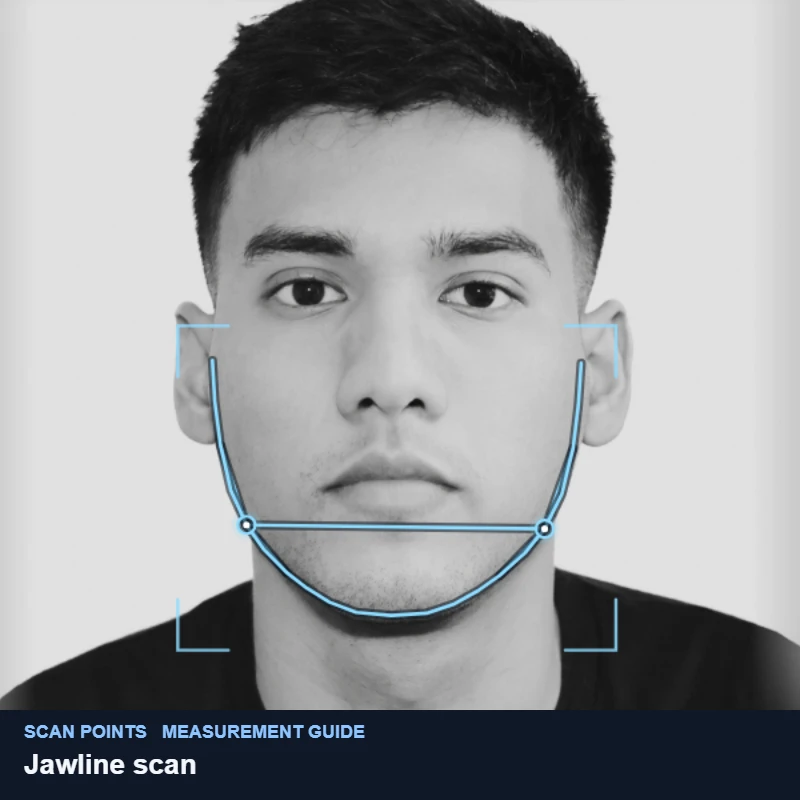
Example result
The jaw outline the jawline test reads, on a demo portrait. Scan guides are enlarged here so you can see what the tool reads.
Jawline score
- Even light
- Neutral expression
- Phone at eye level
- Clean background
- Even lightFace a window. No harsh shadows from above.
- Neutral expressionNo smile, no makeup. Hair off your forehead.
- Phone at eye levelShoulders to top of head. Chin neither up nor down — angle can fake a sharper jaw.
- Clean backgroundPlain wall or neutral space.
Embed this test on your siteFree, no sign-up
Paste this where you want the jawline test to appear: a blog post, a forum signature page, a barber's or clinic's site. It runs in your visitor's browser and never uploads their photo, so there is nothing to add to your privacy policy for it.
What does the jawline test measure?
A jawline reads strong when two things are true: the corner of the jaw below the ear turns sharply rather than sloping into the neck, and the jaw is wide enough relative to the cheekbones that the lower face does not taper into a point. The tool reads both from the face mesh. The first is the jaw angle, the turn at the gonial corner, which it reports as sharper than typical, typical or softer than typical. The second is the jaw-to-cheek width ratio, the width across the jaw angles divided by the width across the cheekbones, reported as a percentage of the cheekbone width. The two are combined into a jawline score. All of it runs on your device; the photo is not sent anywhere.
The angle is described in the glossary under gonial angle, and the bone behind both readings under mandible. The tool describes the corner in words and gives a combined score rather than an angle in degrees, because a photo cannot support one.
How to take the photo for a jawline reading
The jaw is the easiest part of the face to fake with a camera, which is why every jawline selfie on the internet looks sharper than the person does in daylight. The rules below are what make the score mean anything.
- Camera at eye level, chin level. Chin down and camera high tightens the neck and carves a jaw that is not there; chin up hides the angle in the neck.
- Face square to the lens. A three-quarter turn shows one jaw angle in profile and makes it look sharper than it is.
- Arm's length or further. A close lens narrows the jaw relative to the nose and cheeks.
- Front light, not overhead. Overhead light throws a shadow under the jaw and draws an edge that is really shadow. Even front light shows the actual edge.
- Neutral mouth, no clench. Clenching the masseters squares the angle for the duration of the photo.
- Beard trimmed or absent. A beard draws its own jawline over the real one, and the mesh reads the beard's edge.
How to read a jawline score
The score is a single figure built from the two readings. Read them first. A sharper corner with a jaw close to the cheekbone width is what reads as a strong jaw. A typical corner with a narrow jaw reads as a tapered, softer lower face. A softer angle on a photo that followed the rules usually means one of two things: the corner of the mandible is genuinely rounded, or fat under the chin and along the jaw is filling the corner in. The tool cannot tell those apart. The way to find out is to lose some body fat and rescan, and the body fat and the jawline article explains why that is the biggest lever anyone has.
Compare only with your own earlier photos taken the same way. A score from this page is not comparable with a forum rating, a friend's result or another app, because each reads different things from different photos.
What the test cannot tell you
It cannot measure the angle. A gonial angle is measured on a lateral cephalometric radiograph, and no front-facing photo gives one. The band describes how the corner reads in this image, at this head position, under this light, and it can move by a full band between two honest photos. It also cannot see the ramus, the vertical part of the jaw behind the angle, from the front, which is why the full rating reads it as its own band with a capture grade under ramus.
And it cannot tell you what the score should be. A sharp jaw reads as a sex-typical feature in men, which the 2011 attractiveness review supports as one driver among several. It is not the whole rating, and a soft jaw on a face with good skin, symmetry and proportion lands well above the midpoint in the full score. Facial adiposity, the fat layer over the jaw, is separately supported as a cue to perceived health, which is the evidence behind the body-fat lever.
Is the jawline structural or workable?
Split it in two. The angle and the width of the mandible are bone. Chewing gum, jaw trainers, mewing and tapping do not change the gonial angle in adults, and BecomeTen does not recommend jaw surgery at any tier. That part is structural, and the tool's angle band is tagged accordingly in the full report.
The layer over the bone is workable, and it is where almost all visible jawline change comes from. Fat along the jaw and under the chin rounds the corner and blurs the edge; losing it uncovers whatever angle you have. Posture and the camera decide how much of the neck is in the shot. A beard redraws the edge without moving anything. The ranked list of what has evidence, and what does not, is in jawline without surgery.
Questions
What counts as a good jawline score on this test?
A score in the upper range means the angle read sharp and the jaw read wide enough against the cheekbones on this photo. Most lean, well-photographed faces land in the middle to upper range; a very high score is uncommon and usually structural. A lower score on a rule-following photo is a prompt to look at body fat first, because that is the part that moves.
Why is my jawline score lower than my jaw looks in the mirror?
The mirror is lit from wherever you stand, often from above, and you tilt your head and set your chin without noticing. The tool asks for a square-on, front-lit photo with the chin level, which removes the flattering light and the unconscious head angle most people use in the mirror. The score describes the honest view, which is also the view other people get.
Can the jawline test tell if my jaw is weak because of bone or fat?
Not from one photo. A rounded corner and a fat-filled corner look the same to a face mesh. The practical answer is to lower body fat for a few weeks and rescan under the same rules: if the angle band sharpens, it was fat; if it holds, it is bone, and that is structural. Either way the full report says which levers apply.
Does mewing improve a jawline score?
No. Tongue posture does not change the gonial angle or the width of the mandible in an adult, and the score reads exactly those. People who report a sharper jaw after months of mewing have usually also lost fat, changed their posture for the camera, or grown out of adolescence. The article on what mewing does not do goes through the claims one by one.
Will a wider jaw always score higher on the jawline test?
Up to a point. The width part tops out at about 84 % of the cheekbone width; beyond that a wider jaw adds nothing to the score. A jaw much wider than the cheekbones can read heavy rather than strong, and the full rating scores the jaw against the whole face rather than on its own.