Tool · Harmony
fWHR calculator
This fWHR calculator measures your facial width-to-height ratio from one photo, in your browser: cheekbone width divided by the height of the middle of the face. It reports the ratio, a band from narrower to wider, and both measurements, so you can see which one drives it. It is a photo estimate, and fWHR partly tracks body fat.
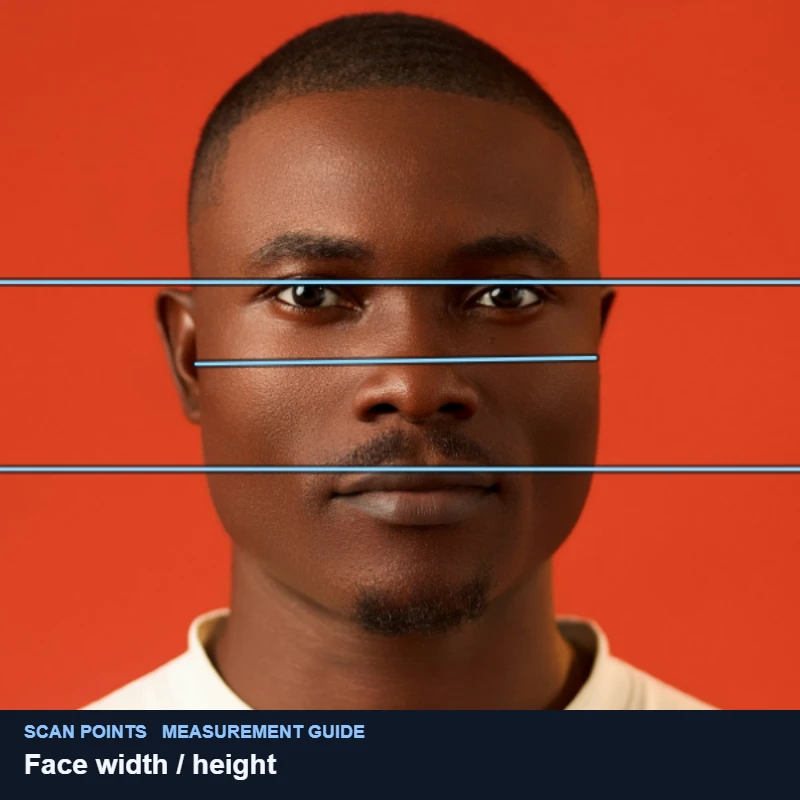
Example result
The width and height the fWHR calculator divides, on a demo portrait. Scan guides are enlarged here so you can see what the tool reads.
fWHR calculator
- Even light
- Neutral expression
- Phone at eye level
- Clean background
- Even lightFace a window. No harsh shadows from above.
- Neutral expressionNo smile, no makeup. Hair off your forehead.
- Phone at eye levelShoulders to top of head. Chin neither up nor down — angle can fake a sharper jaw.
- Clean backgroundPlain wall or neutral space.
Embed this test on your siteFree, no sign-up
Paste this where you want the fwhr calculator to appear: a blog post, a forum signature page, a barber's or clinic's site. It runs in your visitor's browser and never uploads their photo, so there is nothing to add to your privacy policy for it.
What is fWHR?
fWHR, the facial width-to-height ratio, divides the width of the face at the cheekbones by the height of the upper face. A higher number means a broader, shorter midface; a lower one means a narrower, taller one. It became popular in psychology research as a possible cue to perceived dominance and aggression, and from there it reached the looksmaxxing forums, where a high fWHR is often treated as a goal. The fWHR glossary entry covers the history and the replication record.
Research papers measure the height from the brow or from the top of the eyelids to the upper lip, and the width between the widest points of the cheekbones. Different papers pick different endpoints, which is one reason published averages disagree. This tool uses the upper eyelid and the top of the upper lip, because the face mesh finds both reliably on an ordinary photo.
How the fWHR calculator works
A face mesh runs on your photo on your device and places a few hundred landmarks. The tool removes head roll, measures the distance between the two cheekbone landmarks, measures the height from the eyelids to the top of the upper lip, and divides one by the other. It also reports each leg as a share of the face length, so you can see whether a high ratio comes from a wide face or a short midface. Nothing is uploaded; the photo is gone when you close the page.
| Band | What it means | Common cause |
|---|---|---|
| Narrower | Below about 1.7: height large against width | A long midface, a lean narrow face |
| Typical | About 1.7–2.2 on this tool, where most faces land | Average cheekbone width and midface height |
| Wider | Above about 2.2: width large against height | Broad cheekbones, a short midface, or cheek fat |
What is a good fWHR?
There is no good fWHR in the sense the forums mean. The research found that wider faces are sometimes judged as more dominant or aggressive, not as more attractive, and even the dominance link replicates unevenly across studies and populations. What the reviews of facial attractiveness support is averageness, symmetry, sexual dimorphism and skin; a typical fWHR is simply part of an average face.
fWHR also moves with body fat. The 2010 study of visual cues to weight found that width measures of the face track perceived weight, because fat over the cheekbones adds width without changing the bone. A face that gains weight gains fWHR. That is the one workable part of the ratio, and it works in the opposite direction from what the forums want: getting leaner usually lowers fWHR slightly while sharpening the jaw and cheekbones, which the research does link to attractiveness.
How to take the photo for fWHR
- Arm's length or further. A close lens narrows the sides of the face and lowers the ratio. This is the biggest error in fWHR photos.
- Face square to the camera. A turn narrows one cheekbone and lowers the width.
- Camera at eye level, head level. Tipping the chin changes the height leg.
- Neutral expression. A smile lifts the upper lip and widens the cheeks at once.
Questions
Can I increase my fWHR?
Not the bone. Cheekbone width and midface height are set by the zygomatic bones and the maxilla, and no exercise or routine changes them; BecomeTen does not recommend surgery. Facial fat raises the ratio, but that is not an improvement. Getting leaner usually lowers it slightly and makes the cheekbones and jaw read sharper.
Why does my fWHR differ between calculators?
Because they measure different endpoints. Some use the brow, some the eyelids, some the top of the upper lip and some the lip line, and each choice shifts the ratio. Photo distance and head tilt then add their own error. Compare numbers only within one tool and one way of taking the photo.
Is a low fWHR unattractive?
No. The research on fWHR concerns perceived dominance, and even that link is inconsistent. Attractiveness research points to averageness, symmetry, dimorphism and skin. A narrower face with good definition and even skin rates well; fWHR on its own tells you little about how a face is rated.
Sources
- 1.Deciphering faces: quantifiable visual cues to weight — Perception (2010)(Opens in a new window)
- 2.Facial adiposity: A cue to health? — Perception (2009)(Opens in a new window)
- 3.Facial attractiveness: evolutionary based research — Philosophical Transactions of the Royal Society B (2011)(Opens in a new window)