Tool · Eye area
Almond eyes test
Almond eyes are eyes that are longer than they are tall, with the iris touching both lids, white showing mainly at the sides, and a slight upward tilt. It is the most common eye shape. This test reads the opening, the tilt and the brow from one photo, in your browser, and says whether your eyes read almond or which shape they sit closer to.
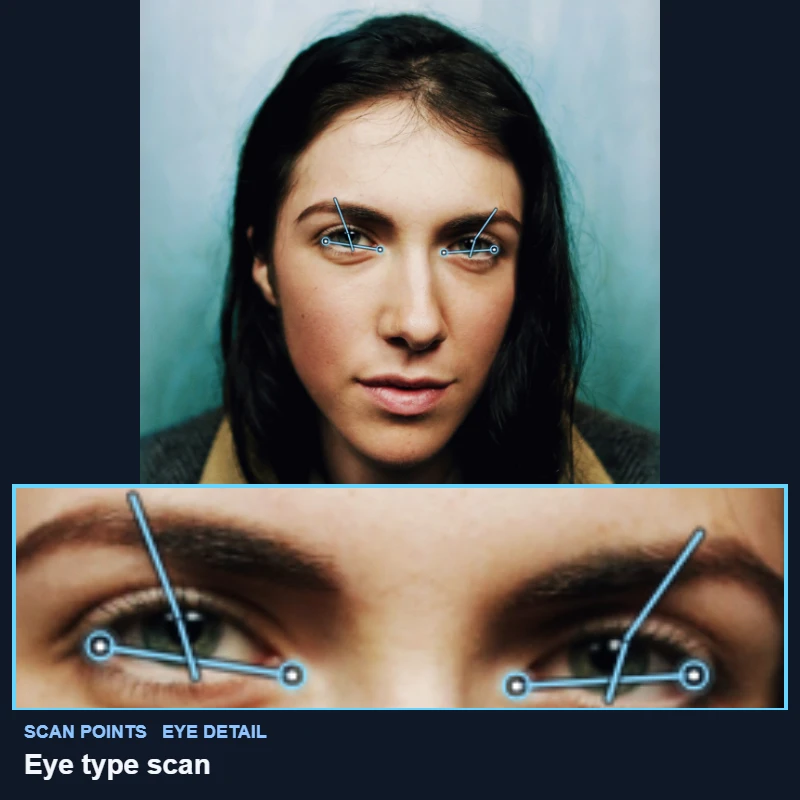
Example result
The eye points the almond eyes test reads, on a demo portrait. Scan guides are enlarged here so you can see what the tool reads.
Almond eyes test
- Even light
- Neutral expression
- Phone at eye level
- Clean background
- Even lightFace a window. No harsh shadows from above.
- Neutral expressionNo smile, no makeup. Hair off your forehead.
- Phone at eye levelShoulders to top of head. Chin neither up nor down — angle can fake a sharper jaw.
- Clean backgroundPlain wall or neutral space.
Embed this test on your siteFree, no sign-up
Paste this where you want the almond eyes test to appear: a blog post, a forum signature page, a barber's or clinic's site. It runs in your visitor's browser and never uploads their photo, so there is nothing to add to your privacy policy for it.
What are almond eyes?
Almond eyes are named for the nut: an oval that tapers to a point at each end. The eye is noticeably wider than it is open, the iris is framed by both the upper and the lower lid, and white shows at the sides rather than above or below. The outer corner usually sits a little higher than the inner one, a slight positive canthal tilt. Makeup artists treat almond as the balanced shape, because it takes almost any look without needing correction.
It is also the ordinary eye. When we measured real frontal photos, the middle of the group was an almond eye: an average opening, a slight upward tilt and a brow at the usual height. That is why the eye type test treats almond as the centre and the other types, fox, siren, doe, hunter and prey, as departures from it in one or two traits.
| Shape | Opening | Tilt | What you see |
|---|---|---|---|
| Almond | Longer than tall | Slightly upward | Iris touches both lids, white at the sides |
| Round (doe) | Tall, open | Level | White above or below the iris |
| Siren | Elongated | Upward | Almond with more lift |
| Fox | Narrow and long | Strongly upward | Almond pulled up and out |
How to tell if you have almond eyes
The iris test is the quickest. Look straight into a mirror at eye level with a relaxed face. If the coloured part of your eye touches the upper and the lower lid, and white shows only at the sides, your opening is almond. If white shows above or below the iris without you widening your eyes, the opening is rounder. Then check the corners: an almond eye tapers to a point at each end and the outer corner sits level with or a little above the inner one.
The test does the same from a photo, with a face mesh that runs on your device. It measures the opening against its width, the tilt from inner to outer corner and the gap from lid to brow, compares each with real frontal photos, and answers the question on this page first: yes, almond, or not almond and which shape is closer, with the percentages and the trait that makes the difference. The eye shape detector reads just the opening and the tilt if you want the simpler label.
Photo rules for the almond eyes test
- Relaxed face. A smile lifts the lower lid and narrows the eye; wide eyes show white and read round.
- No liner or lashes. Winged liner lengthens the eye and fakes an almond or fox shape.
- Camera at eye level. A camera above you makes every eye look rounder and more upturned; one below turns the corners down.
- No glasses, even front light. Lenses change the apparent size of the opening.
Are almond eyes the most attractive shape?
They are the most average shape, and averageness is one of the few facial principles the research on attractiveness supports well. A face whose features sit near the population average tends to be rated as more attractive than one with any feature far from it. That makes almond eyes a safe shape rather than a rare one. The other shapes are not flaws: doe eyes read youthful, fox and siren eyes read striking, and all of them appear on faces people rate highly.
The shape itself is set by the bone of the orbit and the ligaments at the corners and does not change with exercises; BecomeTen does not recommend surgery. What changes how an eye reads is makeup, brow shape, lashes and sleep, which the full rating reads alongside the rest of the eye area.
Questions
Are almond eyes rare?
No. Almond is the most common eye shape. In our measurements of real frontal photos the typical eye was almond: an average opening, a slight upward tilt and a brow at the usual height. The rarer shapes are the ones that depart from it, such as clearly round, clearly narrow or strongly tilted eyes.
Can you have almond eyes and hooded eyes at the same time?
Yes. Almond describes the outline of the opening, hooded describes the skin fold above it, so they combine freely. Hooded almond eyes are common. This test reads the opening, the tilt and the brow height; it cannot see the eyelid crease, so it will not tell you whether your lids are hooded.
What is the difference between almond eyes and round eyes?
The opening. Almond eyes are longer than they are tall and the iris touches both lids, so white shows only at the sides. Round eyes are taller for their width and show white above or below the iris. The test measures that ratio directly and names doe as the closer type when your eyes read round.
Sources
- 1.Human (Homo sapiens) facial attractiveness and sexual selection: the role of symmetry and averageness — Journal of Comparative Psychology (1994)(Opens in a new window)
- 2.Facial attractiveness: evolutionary based research — Philosophical Transactions of the Royal Society B (2011)(Opens in a new window)