Tool · Eye area
Downturned eyes test
Downturned eyes are eyes whose outer corners sit lower than the inner corners, a negative canthal tilt. This test measures the tilt of each eye from one photo, in your browser, removes head roll first, and answers directly: downturned, level or upturned. A true negative tilt is less common than people fear; most photos that look downturned are camera angle.
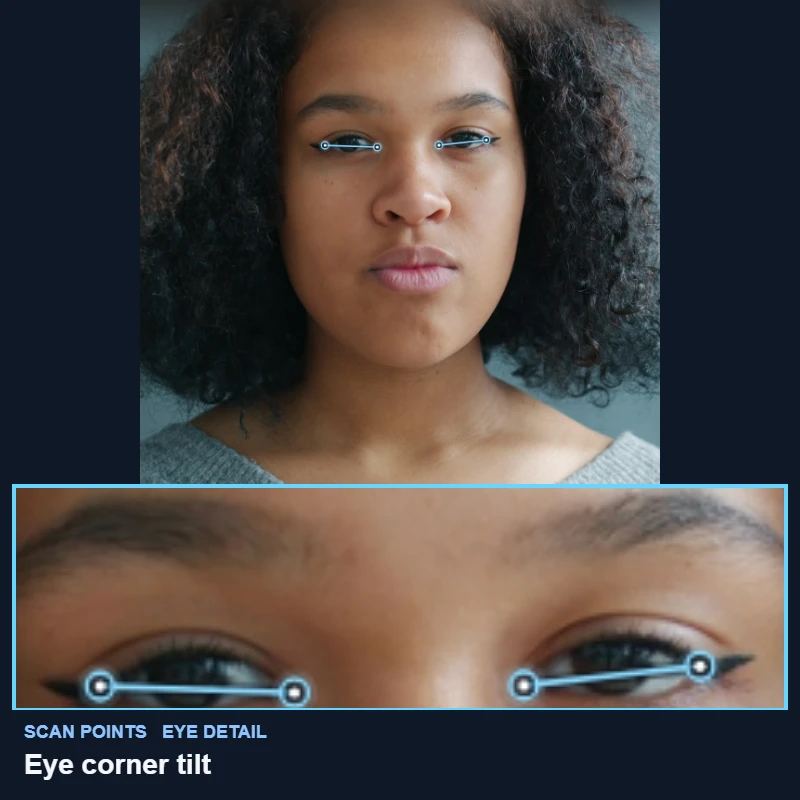
Example result
The eye corners the downturned eyes test reads, on a demo portrait. Scan guides are enlarged here so you can see what the tool reads.
Downturned eyes test
- Even light
- Neutral expression
- Phone at eye level
- Clean background
- Even lightFace a window. No harsh shadows from above.
- Neutral expressionNo smile, no makeup. Hair off your forehead.
- Phone at eye levelShoulders to top of head. Chin neither up nor down — angle can fake a sharper jaw.
- Clean backgroundPlain wall or neutral space.
Embed this test on your siteFree, no sign-up
Paste this where you want the downturned eyes test to appear: a blog post, a forum signature page, a barber's or clinic's site. It runs in your visitor's browser and never uploads their photo, so there is nothing to add to your privacy policy for it.
What are downturned eyes?
Draw a line from the inner corner of each eye to the outer corner. If the outer end drops below the inner, the eye is downturned, and the angle of that line is a negative canthal tilt. The look reads soft, gentle or, in the forums' framing, tired. Many well-known faces have it, and in makeup it is treated as a shape to play up with lower-lash definition rather than a flaw.
A clearly negative tilt is less common than a slight positive one. In our measurements of real frontal photos, the typical eye tilted a little upward and none of the group read downturned on a straight-on photo. That matters because the most common reason an eye looks downturned in a selfie is the camera, not the eye.
| Cause | Real tilt? | What to do |
|---|---|---|
| Camera held below eye level | No | Retake at eye level |
| Chin raised | No | Level the chin |
| Puffiness or tiredness at the outer corner | No | Sleep, then retake |
| Brow tail sitting low over the corner | No, but it reads that way | Brow shaping |
| Outer corner lower than the inner | Yes | A normal variant; framing changes how it reads |
How the downturned eyes test works
A face mesh runs on your photo on your device and finds the corners of each eye. The tool levels the head first, rotating the mesh until the midline is vertical, so a tilted head does not read as tilted eyes. Then it measures each eye's corner line against the horizontal and averages them. The answer comes first, downturned, level or upturned, with each eye's reading shown so you can see if one side differs. Nothing is uploaded.
Within about one degree below flat, eyes read level to most people, and the test says so rather than calling a tiny negative reading downturned. The canthal tilt test shows the same reading number-first.
Photo rules before you believe a negative tilt
- Camera exactly at eye level. Even a little below turns the outer corners down in the image. This is the most common false result.
- Chin level. Raising the chin to look at the phone does the same.
- Rested face, no smile. Puffiness and squinting move the outer corner.
- Two photos. If a second photo taken the same way reads level, trust that one.
Is a negative canthal tilt bad?
No. It is a normal variation of the eye, not a defect, and on its own it is not a health issue. The forums rank it low, and there is a grain of evidence behind the worry: eyes that turn down at the outer corner can read as tired, and perceived tiredness is linked to how the eye area looks. But in real ratings the tilt is a small factor next to skin, sleep, under-eye condition and body fat, and faces with a downturned eye are rated highly all the time.
The tilt is set by the bone of the orbit and the ligaments at the outer corner and does not change with exercises or mewing; BecomeTen does not recommend surgery. What changes how it reads is workable: brow shaping that lifts the tail, sleep that takes puffiness out of the outer corner, and makeup that defines the upper outer lash line.
Questions
Can you fix a negative canthal tilt without surgery?
Not the tilt itself. It is set by the orbit and the ligaments at the outer corner, and no exercise, mewing or routine moves them. You can change how it reads: shape the brow tail upward, reduce puffiness with sleep, and define the upper outer lashes. BecomeTen does not recommend surgery.
Why do my eyes look downturned in selfies but not in the mirror?
Usually because the phone was below eye level or the chin was raised, which tips the outer corners down in the image. A mirror is at eye level. Take the photo with the phone exactly at eye height and the chin level, and the tilt in the photo will usually match the mirror.
Are downturned eyes and hooded eyes the same thing?
No. Downturned describes the tilt of the corner line; hooded describes a fold of skin above the eyelid. They often appear together because a heavy fold at the outer corner makes the eye look downturned, but either can occur alone. This test measures the tilt, not the fold.