Journal · Measurement · capture
Can a photo measure your gonial angle? We tested it
Not from a front-facing photo. When we measured the jaw corner on real frontal photos with a face mesh, every face read a wide, nearly flat angle in a narrow band, far from the true gonial angle a radiograph shows. A side photo gives a rough soft-tissue estimate at best. We stopped reporting a jaw angle in degrees.
The outline and balance of the lower face.
Explore jaw & chinInside this article
Find the part you need.What we tested
The gonial angle is the angle at the back corner of the jaw, where the horizontal body of the mandible turns up into the ramus. It is a staple of looksmaxxing forums, and several online calculators report it in degrees from a single upload, some from a front-facing selfie. Our own jawline test used to do the same: it read the corner of the jaw from the face mesh and scored it against the textbook range.
In September we checked that against reality. We ran the same MediaPipe face mesh the tool uses on ten real frontal photos of different people, and read the jaw corner exactly as the tool did: the angle at the mesh's jaw-corner point between the line up the side of the face and the line along the jaw toward the chin.
What we found
Every face read almost the same thing. The jaw corner came out between about 153 and 166 degrees, with the middle of the group at 160, on faces that plainly differ in how square their jaws look. The textbook adult gonial angle measured on a side X-ray is far more closed than that, and it varies much more between people. A reading that barely moves between a soft jaw and a square one is not measuring the jaw.
| Method | What it measures | Good for |
|---|---|---|
| Lateral cephalogram (side X-ray) | The bony angle, directly | The only true gonial angle |
| Side-profile photo | The soft-tissue outline of the corner | A rough estimate if the corner is visible |
| Front-facing photo | A projection of the jaw line, flattened | How wide the jaw reads, not its angle |
The consequence for our tool was concrete. It scored the angle against a defined range that no front photo can reach, so the angle half of the score came out zero for every face, and every face we tried landed in the thirties, labelled below average. A tool that tells everyone the same bad news is not measuring anything.
Why a front photo cannot see the angle
The gonial angle lives in the side view. From the front, the ramus runs almost straight toward the camera and the body of the jaw runs across the image, so the corner between them is seen nearly edge-on. The projection of an angle viewed that way opens out toward a straight line, whatever the real angle is. That is why the readings clustered near flat, and why they barely changed between faces.
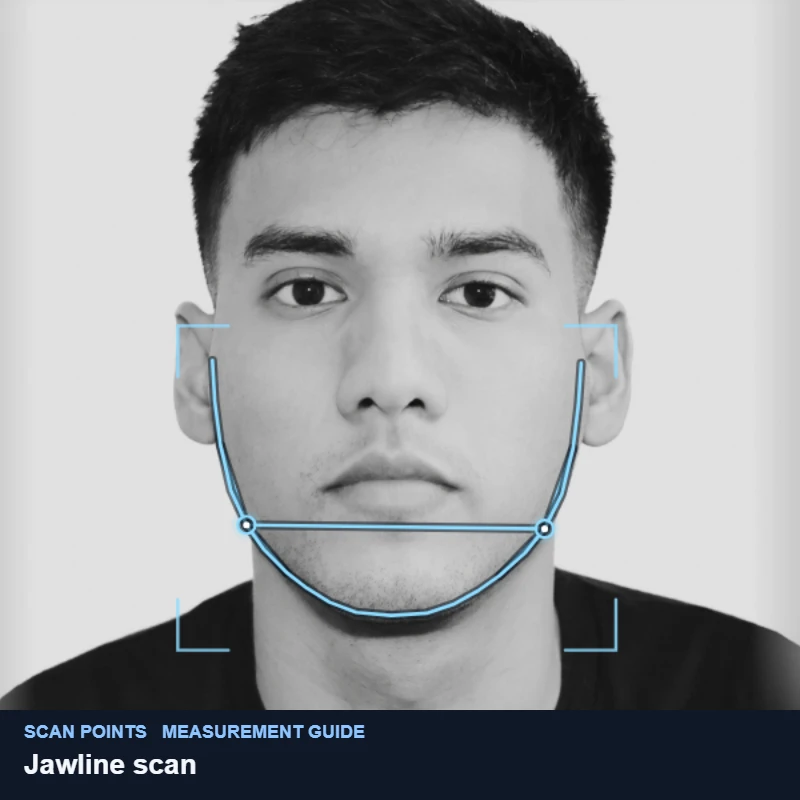
On top of the geometry, the corner is covered. Skin, fat and the masseter muscle sit over the bone (the two perception studies cited below show how readily observers read that fat layer), a beard hides the outline, and lowering the chin by a few degrees rewrites where the corner appears. The photo guides on this site, such as the one on light, angle and lens, cover how much each of those moves a face in a photo; for the jaw corner they move it more than the bone differs between most people.
What we changed
The jawline test no longer reports a jaw angle in degrees. It compares two things with the same set of real frontal photos: how sharply the jaw corner turns in the outline, relative to other faces photographed the same way, and how wide the jaw is against the cheekbones. An average jaw now lands near the middle of the scale, and the result says sharper, typical or softer for a front photo. The face shape detector, which used the same reading, was recalibrated the same way, and so was the hunter eyes test, whose brow measure had the same problem of a textbook target the mesh never produces.
The general lesson is the one the methodology is built on: a photo supports bands, not decimals, and any number a tool reports should be checked against what real photos produce before anyone reads meaning into it. It is also why the same face can score differently on two scans without anything having changed.
What to do with your jaw instead
The gonial angle is bone and does not change without surgery, which BecomeTen does not recommend. What changes how the jaw reads is workable: body fat under and along the jaw, head posture in photos, and beard shape. The jawline without surgery article goes through what the evidence supports, and body fat and the jawline explains why the corner appears when the fat over it goes.
One photo. Then stop guessing.
The full rating reads the jaw as a band with a capture grade, alongside the rest of the face, and names what is workable. Free score, no sign-up.
Questions
Can an app measure my gonial angle from a selfie?
No. A front-facing selfie sees the jaw corner nearly edge-on, so the angle it shows opens out toward flat whatever the real angle is. When we measured real frontal photos, every face read almost the same obtuse corner. An app that returns precise degrees from a selfie is reporting the projection, not your jaw.
How is the gonial angle measured properly?
On a lateral cephalogram, a side X-ray of the skull, by drawing lines along the back of the ramus and the lower border of the mandible and measuring where they meet. It is a clinical measurement used in orthodontics and surgery planning. A side photo can only approximate the soft-tissue outline over that corner.
Why did the jawline test give everyone a low score before?
Because it scored the jaw corner against a textbook range that a front photo never reaches. The angle half of the score came out zero for every face, so everyone landed in the thirties. It now compares the corner and the jaw width with real frontal photos, so an average jaw scores near the middle.