Guide · Framing
Best hairstyle for your face shape: oval, round, square, oblong, heart, diamond
The best hairstyle for your face shape is the one that balances it: height for a round or square face, width and a fringe for an oblong one, weight at the jaw for a heart, softness at the cheekbones for a diamond, and almost anything for an oval. Hair changes what a face reads as, not the bone underneath.
The short version
- 1Identify the face shape from a straight-on photo. Pull hair off the face, photograph at eye level, and compare forehead width to jaw width, face width to face length, and whether the jaw meets the chin in a curve, a corner or a point. The face shape tool does this from one photo.
- 2Decide what the shape needs to balance. Round and square faces need length and softened corners; oblong faces need width and a shorter visible forehead; heart faces need weight at the jaw; diamond faces need width above and below the cheekbones; ovals need only proportion kept.
- 3Place volume where the face is narrow. Ask for height on top for round and square faces, width at the sides for oblong and diamond faces, and weight at or below the jaw for heart faces. Volume added at the widest point works against every shape.
- 4Use the fringe to shorten or cover. Add a fringe for oblong, heart and diamond faces, side-swept for square and heart, straighter for oblong. Skip a blunt fringe on a round face, and keep any fringe off the eyes so the eye area still reads.
- 5Set the sides and the ends away from the widest point. Keep sides tight where the face is wide and longer where it is narrow, and never end a blunt cut at the widest point of the face. Check the result in a matched photo rather than the barber's mirror.
See how a cut frames the same face
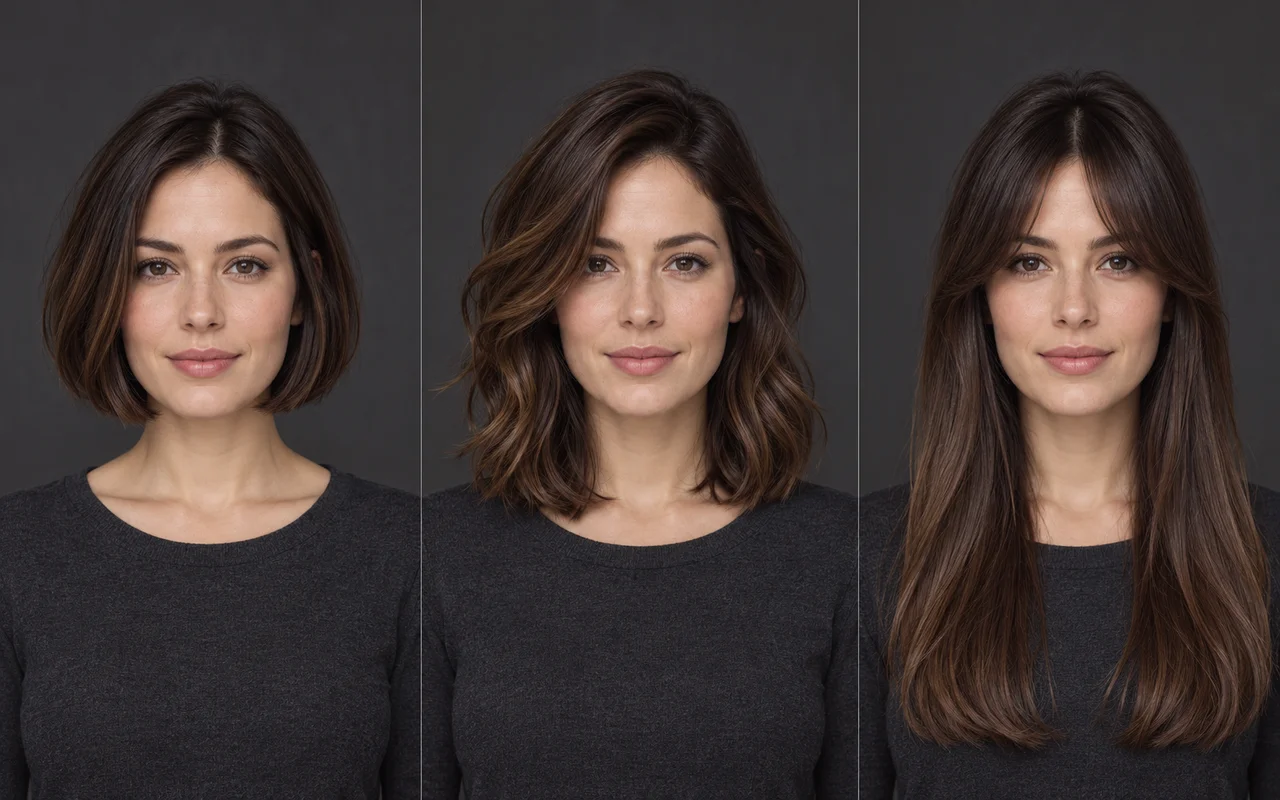
Compare the outline, not an attractiveness score. The crop above brings a fringe onto the forehead; the quiff adds height; the loose side part adds movement. Below, a bob puts a clear edge near the jaw, layered waves add side volume, and curtain fringe frames the forehead. These are style examples, not a recommendation that every face should wear the same cut.
First, find the shape
Every hairstyle chart assumes you already know your face shape, and most people guess wrong, usually toward oval because oval is the one every chart flatters. The honest way to find it is a straight-on photo at eye level, hair pulled off the face, and a comparison of three things: the width of the forehead against the width of the jaw, the width of the face against its length, and how the jaw meets the chin, whether in a curve, a corner or a point.
The free face shape tool reads those from one photo in the browser and returns the shape with the reasoning, so you do not have to squint at a mirror with a ruler. Take the reading as a category, not a measurement; most faces sit between two shapes, and the tool will say so. The chart below is written for the six shapes the tool distinguishes, and the mixed cases usually take the advice for the shape they lean toward.
The chart: what each face shape needs to balance
| Face shape | What to balance | Styles that tend to work | Styles that fight it |
|---|---|---|---|
| Oval | Nothing in particular; length and width already sit in proportion, so the aim is to keep them there | Most cuts. Medium lengths, side parts, textured crops, layers that follow the jaw. Choose for hair type and lifestyle | Extreme height with shaved sides on a narrow oval, which turns it into a long face; heavy straight fringes cut low |
| Round | Add length and take width; the face reads wider than it is long and the jaw is soft | Height on top with shorter sides, a deep side part, an off-centre parting, layers below the chin, an asymmetric fringe | Chin-length bobs that end at the widest point, round curls at the cheeks, blunt fringes straight across, volume at the sides |
| Square | Soften the corners; the jaw and forehead are about equally wide and the jaw meets the chin at an angle | Texture and movement rather than hard edges: layered cuts, a soft side-swept fringe, waves, a longer crop with a loose top | Blunt bobs ending at the jaw, straight geometric fringes, very short back and sides with a flat top that repeat the square |
| Oblong | Take length and add width; the face is noticeably longer than it is wide and often has a high forehead | A fringe of almost any kind, volume at the sides and around the cheekbones, chin- to shoulder-length cuts, a low side part | Height on top, tight sides, long straight hair with no layers, centre partings and slicked-back styles that expose the whole forehead |
| Heart | Balance a wide forehead against a narrow, often pointed chin | Weight and width at or below the jaw: a chin-length bob, a side-swept fringe that covers part of the forehead, layers from the cheekbones down | Volume at the crown or temples, slicked-back styles that show the full forehead, very short cuts that leave the chin isolated |
| Diamond | Soften the widest point at the cheekbones against a narrow forehead and chin | Fringes and forehead coverage to add width above, chin-length or jaw-grazing layers to add width below, tucking hair behind one ear | Height on top with slicked sides, styles that pull hair tightly back, volume that starts and ends at the cheekbones |
Every row follows the same rule: put volume where the face is narrow and take it away where the face is wide, and use a fringe to shorten a long face or cover a broad forehead. If you remember the rule you can judge a cut the chart does not list.
The three framing principles behind the chart
Volume placement. Hair adds apparent size wherever it sits: volume on top lengthens the face; volume at the sides widens it; volume at the jaw adds weight to the lower third. A round face wants the first, an oblong face the second, a heart face the third. Getting this one principle right is most of the work, and it is the principle the face shape tool is built around.
The fringe. A fringe is the only tool that shortens a face without changing anything else, because it moves the visible top of the face down. It helps oblong, heart and diamond shapes; on a round face only a side-swept or curtain fringe works, and a straight one fights it. The length and cut of a fringe matter less than its direction, side-swept or straight: side-swept softens and adds a diagonal, which suits square and heart faces; straight adds a horizontal, which suits oblong faces and fights round ones.
The sides. Where the sides end and how tight they are decides how wide the face reads at the cheekbones and the jaw. Tight sides expose the widest point and suit round and square faces, where the aim is to let the top do the work; longer sides hide it and suit oblong and diamond faces, where width is wanted. This is also why the same cut can look right on one person and wrong on another with a similar shape: the sides were left different lengths.
Find my face shape
Free · one photo in the browser · the tool names the shape and shows why
Hairstyles by face shape for men
Men's cuts have less length to work with, so the levers are height, the sides and the fringe. A round face is best served by a cut with real height on top, a quiff, a textured crop pushed up, or a pompadour, with sides taken short and a parting off centre. A square face wants the same height but with more texture and less edge, so the top is loose rather than flat and the sides fade rather than stop. Add a beard that is shaped along the jaw, kept short at the sides and slightly longer at the chin, and a square jaw reads strong rather than boxy.
An oblong face is the one most men's charts get wrong, because the fashionable cuts, high fades with height on top, are exactly the ones that make it longer. Keep the sides at medium length, keep the top short to medium, and consider a fringe or a forward-swept top. A beard on an oblong face should be kept short at the chin, since length there adds to the lower third. Heart and diamond faces gain from a bit of length at the sides, a textured fringe, and, for those who grow one, a full beard that adds weight to a narrow chin on a heart face, and a chin-focused beard with moderate sides on a diamond face. How a beard redraws the lower third is covered in eyebrows, beard and the perceived jaw.
Where the hairline is receding, the shape advice still holds but the cut has a second job. Shorter styles with the hair kept at a uniform length generally read better on a thinning crown than length combed across it, and a receding front on an oblong face argues for a fringe from what remains rather than a slicked-back top. The medication side, what minoxidil and finasteride showed in trials, is in minoxidil vs finasteride for the hairline.
Hairstyles by face shape for women
With more length, the question becomes where the cut ends and where the layers start. The single most useful rule: do not end a blunt cut at the widest point of the face. A chin-length bob on a round face ends exactly where the cheeks are widest and doubles the width; the same bob on a heart face ends at the narrow chin and balances it. Layers that begin below the widest point and volume that begins where the face is narrow are the two moves that recur in every row of the chart.
A round face is best served by length past the chin, long layers, a deep side part and an off-centre fringe if one is wanted. A square face takes soft layers, waves and a side-swept fringe, with the ends kept below or well above the jaw. An oblong face is the one that benefits most from a fringe, straight or curtain, plus width from waves or layers at the cheekbones, and it is the one that should avoid long, straight, centre-parted hair. Heart shapes take chin-length cuts, side fringes and layers that start at the cheekbones; diamond shapes take forehead coverage plus width at the jaw, and look good with hair tucked behind one ear to break the symmetry at the cheekbones.
Oval faces can wear most of this, which is why the shape is treated as the reference in most charts. The one thing that works against an oval is a cut that overcommits to a single dimension, very high volume with tight sides on a narrow oval, or a low heavy fringe on a short one.
Glasses, brows and the parting: the rest of the frame
Hair is the largest frame but not the only one. Glasses add a horizontal line at the eyes and can widen or narrow the midface in a photo; the companion guide to glasses by face shape uses the same six shapes. Brows set the top of the eye area, and a brow tail that has been tidied so it does not droop below the outer corner of the eye changes how rested the eyes look more than any cut does. The parting decides where the eye enters the face: a centre parting emphasises symmetry and length, a side parting adds a diagonal and softens both.
Together these are what BecomeTen calls framing: the edges that change what a face reads as without changing the face. A rating reads the photo in front of it, so framing moves the harmony and eye-area bands within their small caps, and the report says so honestly. The general principles are in glasses, hairstyle and framing, and the vertical proportion a fringe plays with is defined at facial thirds.
A guide for each face shape
Questions
Which face shape has the most hairstyle options?
Oval, because its length and width already sit close to the proportion most charts treat as the reference, so a cut has nothing to correct. The practical consequence is that oval faces should choose for hair type, density and lifestyle and only avoid cuts that overcommit to height or to a heavy low fringe.
Does the best hairstyle for a round face differ between men and women?
The principle is the same, add length and take width, but the tools differ. For men that means real height on top, short sides and an off-centre parting. For women it means length past the chin, long layers and a deep side part, and above all not ending a blunt cut at the cheeks.
Can a haircut change my face shape reading in the tool?
It can change the photo enough to move a borderline reading, which is why the tool asks for hair off the face. A fringe hides the forehead height and hair at the sides hides the cheek width, so a reading taken with the cut in place is a reading of the frame rather than the face. Pull the hair back for the measurement, then style for the result.
What hairstyle makes an oblong face look shorter?
A fringe, first, because it lowers the visible top of the face. Then width: waves, layers or volume at the cheekbones, sides kept at medium length rather than tight. Avoid height on top, slicked-back styles and long straight centre-parted hair, all of which add to the length the shape already has.
Is the hairstyle advice here based on studies?
No, and the page says so. There are no trials of haircuts by face shape; the chart is composition, the same principles a stylist uses, and BecomeTen labels framing steps in a plan as having no studies. The one supporting citation is for averageness in the perception literature, which explains why balance reads well, not which cut to get.