Journal · Composition · evidence
Glasses, hairstyle and framing: how the edges change what a face reads as
Framing changes what a face reads as without changing the face. Hair height and fringe alter the visible thirds; volume at the sides alters apparent width; glasses redraw the brow line and eye area; a parting can mask or reveal asymmetry. BecomeTen asks for hair off the face precisely because framing is composition, not structure.
Inside this article
Find the part you need.Why does framing change what a face reads as?
Hair and glasses form a frame around your face. More height can make the face appear longer; more side volume can make it appear wider. The face itself has not changed.
Research links symmetry and average proportions with rated attractiveness, but the studies cited here do not test haircuts or glasses. The styling suggestions below are practical conventions, not proven ways to raise a score.
How does hairstyle change forehead height and the thirds?
The upper third of the face runs from hairline to brow, and hair sets where the viewer thinks the hairline is. A fringe brought down to the brow shortens the visible upper third and makes a long face read shorter and the eyes read higher. Hair swept up and back exposes the whole forehead and does the opposite: a short upper third reads longer, and a face that is wide relative to its height reads taller. The facial thirds page explains the proportion and what the model does with it.
A receding hairline is the case people ask about most. Recession moves the real hairline up and lengthens the upper third, which is why the Norwood scale matters to a rating beyond hair alone. Framing can hide some of it, by bringing hair forward or by wearing it short enough that the temples stop reading as a line, but that is concealment and the hair article covers what has actual evidence for density. A plan may suggest both: the framing now, the treatment for the months it takes.
Does volume at the sides change apparent face width?
Yes, in both directions. Hair left full at the sides adds to the outline the viewer reads as the head and, at the level of the cheekbones, to the outline read as the face. A narrow face with side volume reads wider and shorter; a wide face with side volume reads wider still. Tight sides do the reverse: the face's own edge becomes the outline, so a wide face reads more compact and a narrow face reads narrower.
This is the framing version of fWHR, the width-to-height ratio the community argues about. The ratio itself is a bone measurement, taken between the cheekbones and from the eyelids to the upper lip, and no haircut changes it; the fWHR calculator reads it from a photo. What the haircut changes is the ratio the viewer estimates before they measure anything, which for a photo is the only ratio anyone actually sees. Height on top works the same way for length: volume above the crown lengthens the apparent face, a flat top shortens it.
What do glasses do to the eye area and brow line?
Frames add a second brow line, a second pair of eye outlines and, at the outer corner, a second canthal angle. The eye area is read against all of them. A frame whose top edge sits along the natural brow merges with it and disappears; one that sits well below leaves a double line and shortens the eye area; one that sits above the brow hides it and reads as a heavy ridge. The outer corner of the lens does what a brow tail does for canthal tilt: an upswept corner makes the eye read as tilted upward, a drooping corner the reverse.
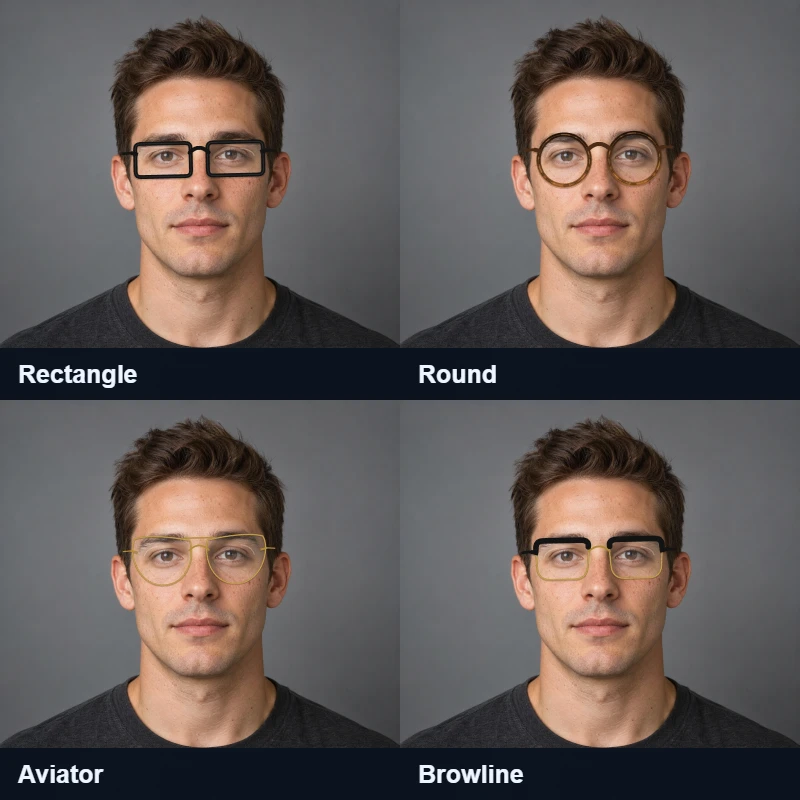
Frame width also interacts with the face's width and with eye spacing. A frame wider than the face at the temples reads as a wide face; a narrow frame on a wide face reads as small eyes. A visible, dark bridge shortens the apparent gap between the eyes; a thin or clear bridge leaves it as it is. None of this is subtle, which is why an optician spends time on it, and why the scan wants the glasses off.
Can a parting hide asymmetry?
Partly, and in two ways. A parting is itself an asymmetric line, and a viewer reads the face on either side of it against that line. Parting on the side where the face is fuller or the brow sits higher tends to balance the impression; parting the other way exaggerates it. The second effect is coverage: a fringe or a sweep that falls over the less even side hides the edge the viewer would otherwise compare.
The symmetry underneath is unchanged, and facial symmetry is one of the traits the model reports because the perception research supports it. Small asymmetry is normal and nearly universal; the framing trick is for making it less noticeable in a photo, not for chasing a perfectly mirrored face that almost nobody has. If the report tags asymmetry, it will say what kind; some of it is posture and camera position, which the photo guide explains, and only the rest is you.
Why does BecomeTen want hair off the face for the scan?
Because the scan is trying to read the face, not the frame. Every effect on this page changes what a viewer estimates without changing what is there. If the model rated the framed face, a fringe would raise the harmony score, side volume would change the width bands, and glasses would shift the eye area, all with no change in the person. A rating that moves with a haircut is not a rating of a face, and the comparison between two scans would be a comparison of two hairstyles.
So the scan asks for hair off the forehead and ears, no glasses, no hat. The structural bands the model returns are then bands of the face, and the methodology can honestly call them that. The plan works the other way round: once it knows the face, it can suggest framing that flatters it, tagged workable, because a haircut is something you can do this week. The plan is allowed to use composition; the measurement is not.
Hair back, glasses off, neutral expression. The plan can suggest the framing afterwards.
What is the evidence level for framing advice?
Questions
Does a fringe change the harmony score?
It would if the model rated framed faces, which is why the scan asks for hair off the forehead. With the hair back, the harmony bands are read from the face itself and a fringe cannot move them. In everyday photos a fringe changes how the upper third reads, and the plan may suggest one for a long face; that is composition, and it is tagged as such.
Can glasses frames make eyes look less close-set?
To a degree. A thin or clear bridge and frames that are not much wider than the face leave the gap between the eyes reading as it is, while a heavy dark bridge draws the eyes together. Slightly upswept outer corners lift the eye area. None of it changes the interpupillary distance, which the model reads as a band from a glasses-free photo.
Does hair volume on top make a long face look longer?
Yes. Height above the crown extends the outline the viewer reads as the face, so a face that is already long relative to its width reads longer still. A long face is usually better served by some volume at the sides and less on top, and a short, wide face by the reverse. These are stylist rules, not trial findings, and a modest version is enough.
Will the plan tell me to change my haircut?
Sometimes. If the model finds that a structural trait such as a long upper third or a wide midface is one of your weak points, the plan may suggest a framing change, because a haircut is one of the few workable levers on a structural trait. It is tagged workable with the “no studies” evidence level, since it rests on stylist consensus, and it never claims to change the trait itself.
Sources
- 1.Facial attractiveness: evolutionary based research — Philosophical Transactions of the Royal Society B (2011)(Opens in a new window)
- 2.Human (Homo sapiens) facial attractiveness and sexual selection: the role of symmetry and averageness — Journal of Comparative Psychology (1994)(Opens in a new window)